Australian SME Directors Risk Losing Homes as Short-Term Loan Defaults Surge
Australian small business owners face growing risks from personal guarantees on short-term loans as court actions involving non-major-bank lenders reach record levels. Insolvency firm Jirsch Sutherland warns that struggling businesses could leave directors facing bankruptcy and losing personal assets, including their homes, if they fail to repay guaranteed debts.
 Harry Taruva
Sydney — Australian small business owners are being urged to reconsider personal guarantees on short-term loans as court actions involving non-major-bank lenders hit a record high, raising concerns about the personal cost of mounting business debts.
The warning comes from insolvency firm Jirsch Sutherland, which says more financially distressed small and medium-sized enterprises (SMEs) are borrowing to cover immediate expenses, including wages, supplier bills and tax obligations, while putting their homes and other personal assets at risk.
Jirsch Sutherland Partner, Malcolm Howell, said some Directors were using expensive loans to keep struggling businesses operating without fully appreciating the consequences if their companies collapsed.
“Directors aren’t taking on these loans for growth; they’re using them as a temporary lifeline to pay employees, suppliers and the ATO just to keep the doors open,” Howell said.
Figures from Alares Credit Risk Insights show court actions by lenders outside Australia’s Big Four banking groups rose to a record level in the September 2026 quarter, exceeding the same period last year.
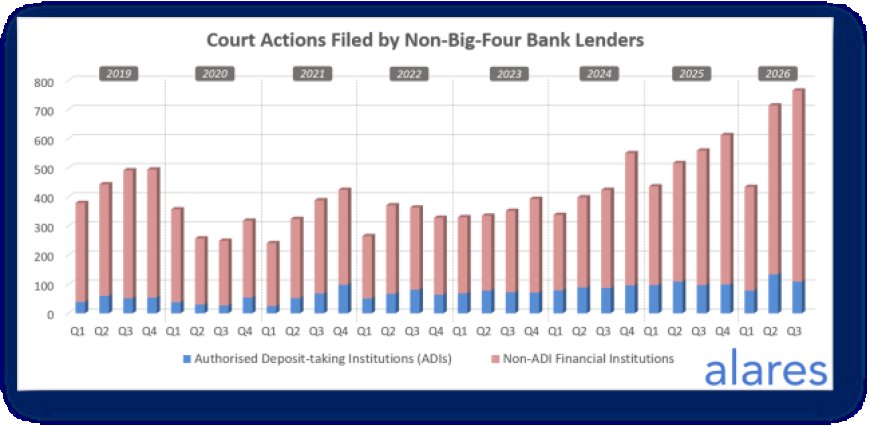
Non-authorised deposit-taking institution (non-ADI) lenders drove the increase, which Alares linked to greater use of private credit and non-major-bank finance.
The trend reflects the growing role of alternative lenders in funding Australian businesses. Research released by ScotPac in June found that 34% of SMEs had obtained non-bank lending in the preceding 12 months to support working capital.
Reserve Bank of Australia research has also documented an increase in the non-bank share of SME lending since 2022, particularly among smaller loans. Such finance can help businesses manage temporary cash shortages, but its cost and contractual conditions can create additional pressure when borrowers are already struggling.
Howell said the speed of alternative lending, including offers of same-day approval, could make it attractive to owners facing urgent bills.
However, he warned that loans secured against business assets could restrict refinancing options, while personal guarantees could expose directors to claims beyond the company itself.
“Short-term finance can be the right tool for a viable business facing a genuine, temporary cash flow gap,” he said.
The concern, he added, was businesses taking on further expensive debt to meet existing obligations before exploring restructuring options.
This could make a Small Business Restructuring (SBR) process more difficult or render it unviable.
A dessert manufacturer approached the firm for restructuring assistance with about AU$200,000 owed to unsecured creditors.
Approximately 75% of the debt was owed to two short-term lenders, both of which held personal guarantees from the Director.
The Director's personal exposure would remain despite the company pursuing restructuring or liquidation, and he is now taking steps to sell his home to meet the liabilities.
In a separate case, a transport company borrowed about AU$75,000 from a short-term lender to manage cash flow amid rising costs and a shortage of drivers.
The Director guaranteed the loan personally.
Following the company's liquidation, the Director entered personal bankruptcy.
His trustee is now moving to realise his home, after the lender lodged a caveat over the property immediately following the liquidation, despite not being the company's largest creditor.
Howell said business owners needed to understand that a company's collapse did not automatically extinguish their personal obligations under a valid guarantee.
“Liquidation doesn’t make a valid personal guarantee disappear,” he said.
He urged Directors to obtain restructuring advice before taking on additional debt or signing guarantees, stressing that seeking professional guidance did not automatically mean a company had to enter insolvency.
Jirsch Sutherland, established in 1984, provides corporate and personal insolvency services across Australia, including liquidations, voluntary administrations, receiverships and bankruptcy.