Dinson Iron and Steel Company Targets 70MW Power Generation as Steel Expansion Gathers Pace
Dinson Iron and Steel Company targets 70MW captive power generation, local employment and road upgrades as its steel complex expands production and industrial capacity.
 Dumisani Ndlovu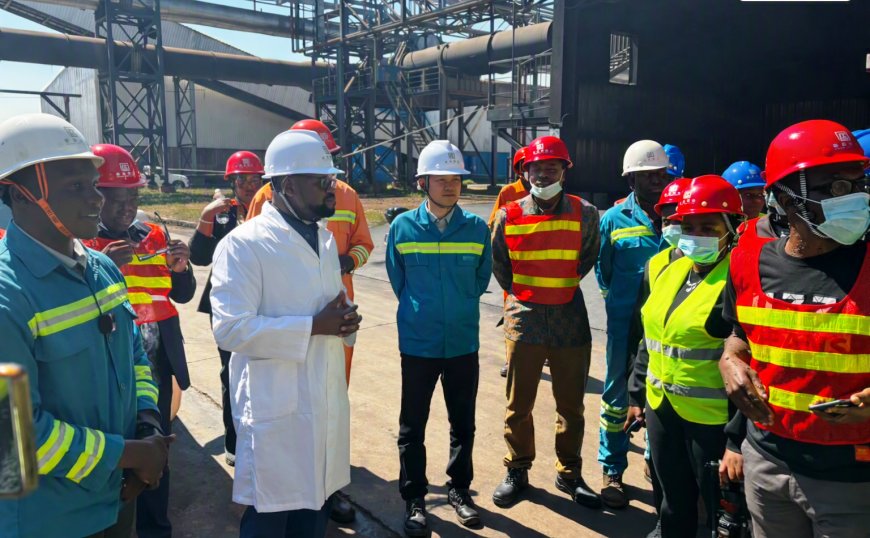
Mvuma— Dinson Iron and Steel Company (DISCO) says it is developing up to 70 megawatts of captive electricity generation capacity at its steel plant, a move expected to meet its own industrial demand while creating scope for surplus power to be fed into Zimbabwe’s national grid.
Speaking to journalists during a recent media tour, DISCO mechanical engineer Munashe Chihambakwe said the company was developing two power-generation systems using different energy sources.
He said a 50MW thermal power plant would use coal and circulating fluidised bed combustion technology to generate steam for turbines, while a separate 20MW system would recover waste heat and gases generated during steel production.
“For the 50MW, the source of energy is coal,” Chihambakwe said, explaining that the second 20MW system would utilise heat and gases from processes including the blast furnace and steel plant.
The company’s first production line requires about 40MW, meaning the planned 70MW generation capacity would provide a significant surplus once fully operational.
Chihambakwe said DISCO was already working towards synchronising the excess electricity with the national grid.
“We are in the process of synchronisation to put the excess into the national grid,” he said, adding that discussions were underway with the relevant authorities to ensure that the technical requirements were met.
The development comes as the company continues to expand its operations and diversify its production lines, with Chihambakwe saying the organisation remained in an investment and development phase.
He said it was therefore too early to quantify annual profits, as resources were still being channelled into developing new production capacity and products.
“We are still investing in it to be there in the future,” he said, describing continuous investment as part of the company’s operating model.
local employment
The steel producer also highlighted the role of the project in creating employment opportunities for communities surrounding its operations.
Chihambakwe said approximately 60 percent of DISCO’s workforce had been drawn from the local community, particularly during the construction phase.
According to him, many local recruits initially joined the project as unskilled workers before receiving on-the-job training that enabled them to acquire semi-skilled competencies.
The company is now working with relevant boards to have some of those workers formally assessed and certified.
However, the scale and technical nature of the project has also required DISCO to recruit skilled personnel from other parts of Zimbabwe.
Chihambakwe said technical and professional employees had been drawn from institutions and universities including the University of Zimbabwe, National University of Science and Technology and Midlands State University.
environmental compliance
Chihambakwe said environmental considerations were incorporated into the company’s projects through Environmental Impact Assessments.
He maintained that DISCO conducts an EIA for every project undertaken within the organisation, saying the company had several assessments covering its various developments.
The emphasis on environmental assessments comes as the company expands its industrial footprint and introduces additional production facilities.
road construction
Beyond its industrial operations, DISCO is also undertaking improvements to the access road serving the plant.
Chihambakwe said construction of a concrete road was underway, with some sections being prioritised because of their proximity to a school.
He said the company had first concentrated on sections regarded as hotspots, particularly areas where dust generated by traffic could affect schoolchildren.
The full road connecting the plant to the main road is expected to be completed by the end of August, according to the company.
The road project is part of DISCO’s wider infrastructure interventions around its operations as the company works to support the movement of workers, goods and industrial traffic.
Chihambakwe also said a cement production line was expected to come on stream in October, adding another dimension to the company’s expanding industrial operations.
With the planned 70MW generation capacity, local workforce development, additional production lines and infrastructure projects, DISCO is positioning its steel complex as a broader industrial hub while seeking to integrate its operations with Zimbabwe’s national energy system.
Dinson Iron and Steel Company (DISCO) is a subsidiary of Tsingshan Holding Group of China, one of the world’s largest stainless steel producers.It is an integrated steel plant located in Manhize near Mvuma. The plant is equipped with a carbon steel plant and an iron ore mine with a capacity of producing tonnes of iron and steel products per year.