Ramaphosa Renews SADC Call for Unconditional Lifting of Zimbabwe Sanctions
By Delicious Mathuthu — SADC Chairperson, Cyril Ramaphosa, has renewed calls for the complete and unconditional lifting of sanctions on Zimbabwe, saying the measures add to the country’s economic challenges. President Emmerson Mnangagwa also demanded their removal as regional leaders call for dialogue, economic transformation and stronger regional integration.
 Delicious Mathuthu
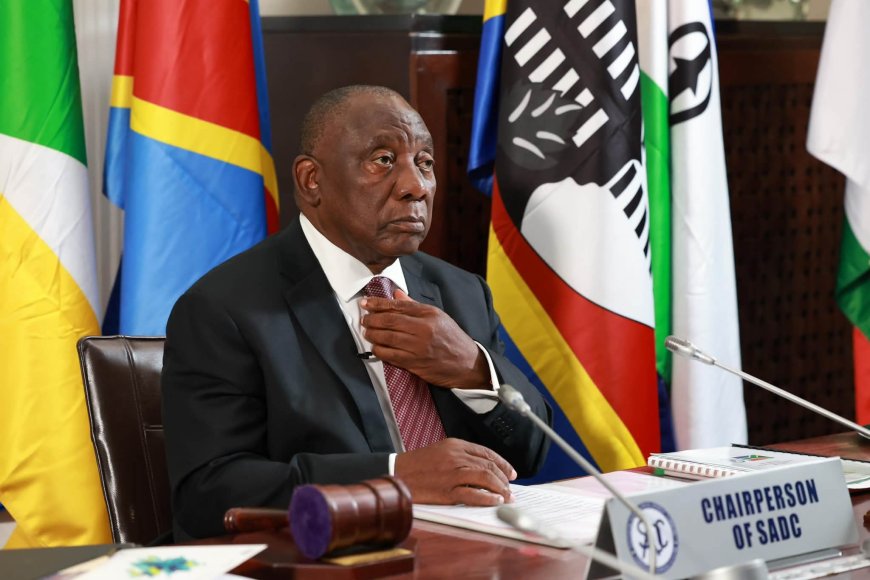
Pretoria/Harare — Southern African Development Community (SADC) Chairperson and South African President, Cyril Ramaphosa, has reiterated the regional body’s demand for the complete and unconditional lifting of sanctions on Zimbabwe, describing the measures as an added burden amid global economic and geopolitical challenges.
In a statement marking SADC Anti-Sanctions Day, held on 25 October, Ramaphosa said the 16-member regional bloc joins Zimbabwe in commemorating the occasion under the theme “Leveraging Regional Integration and Global Partnerships for Economic Transformation Beyond Illegal Sanctions.”
“Today, our Regional Economic Community sends one message to the world: we seek the complete and unconditional lifting of sanctions on our sister nation, the Republic of Zimbabwe,” Ramaphosa said.
He said the sanctions are an additional burden for Zimbabweans in an already difficult international environment and argued that measures against Zimbabwe amount to sanctions against the wider SADC region.
He called for dialogue and for the international community to prioritise the welfare of Zimbabwe’s roughly 17 million people.
Zimbabwean President Emmerson Mnangagwa, speaking at the commemorations, similarly demanded the immediate and unconditional lifting of what he termed heinous and unjustified illegal unilateral sanctions, saying they impede economic development, access to finance, and regional integration.
The annual anti-samctioms day observance was established by the 39th SADC Summit in Tanzania in 2019.
Western restrictive measures on Zimbabwe originated in the early 2000s, linked primarily to the government’s fast-track land reform programme that redistributed commercial farmland from white owners to black Zimbabweans, alongside concerns over governance, political violence, human rights and the rule of law under then-President Robert Mugabe.
The United States enacted the Zimbabwe Democracy and Economic Recovery Act (ZDERA) in December 2001. The law conditioned U.S. support for multilateral financing and debt relief on progress in areas including democracy, land reform compensation and economic reforms.
In 2003, the U.S. established a Zimbabwe-specific sanctions programme under executive orders, targeting individuals and entities.
The European Union imposed an arms embargo, travel bans and asset freezes from 2002, later refined in subsequent decisions.
The United Nations deemed the sanctions regime against Zimbabwe illegal.
These measures were repeatedly extended or adjusted over the years.
Supporters of the sanctions argued they targeted officials and networks responsible for undermining democracy or involved in corruption and rights abuses, without imposing comprehensive trade or economic embargoes on the country as a whole.
Zimbabwean authorities and regional allies have long characterised them as illegal, unilateral and punitive, blaming them for economic difficulties, reduced foreign investment, higher costs of doing business, and constrained access to international finance.
Of late, significant changes have narrowed the scope of the measures in recent years.
In March 2024, the United States terminated its long-standing Zimbabwe-specific sanctions programme and the associated national emergency.
All designations solely under that programme were removed, however, the U.S. Treasury simultaneously designated President Emmerson Mnangagwa, Vice President Constantino Chiwenga and other individuals and three entities, including companies linked to businessman Kudakwashe Tagwirei, under the Global Magnitsky Human Rights Accountability Act for alleged involvement in corruption or serious human rights abuses.
The targeted designations remain in place.
ZDERA itself remains U.S. law, with some U.S. officials stating that it has never been invoked to block multilateral lending or debt restructuring, and is not itself a sanctions programme, though Zimbabwe continues to call for its repeal.
Separate U.S. visa restriction policies related to democracy concerns have also been applied.
On the other hand, European Union has progressively eased its measures. By February 2025, the last remaining entity, the Zimbabwe Defence Industries, had been delisted.
In February 2026, the EU lifted all provisions allowing for travel bans and asset freezes.
The only remaining EU measure is an arms embargo, which was extended until 20 February 2027.
The bloc also retains restrictions on equipment that it says could be used for internal repression.