Ramaphosa Calls for Deeper South Africa-Zimbabwe Economic Cooperation
South African President Cyril Ramaphosa has called for stronger trade, investment and economic cooperation with Zimbabwe, identifying agriculture, energy, mining, transport, tourism, finance and digital technology as key areas for growth.
 Delicious Mathuthu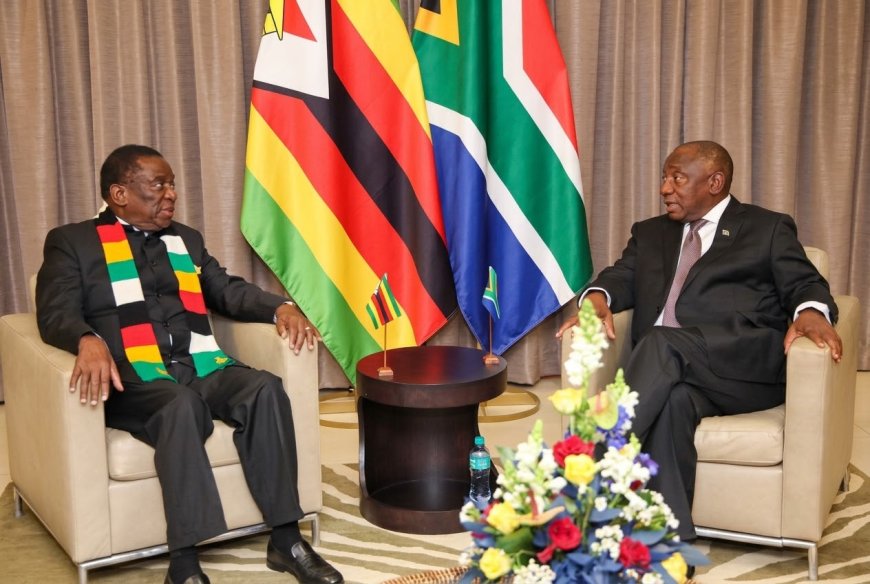
Pretoria — South African President Cyril Ramaphosa has called for stronger economic cooperation between South Africa and Zimbabwe, urging the two countries to turn agreements reached under the Bi-National Commission into tangible benefits for their people.
President Ramaphosa made the call on Friday, August 21, 2026, while delivering closing remarks at the Fourth Session of the South Africa-Zimbabwe Bi-National Commission (BNC) held at the OR Tambo Building in Pretoria, where he hosted Zimbabwe President, Emmerson Mnangagwa, and his delegation.
He said Zimbabwe remained a strategic partner for South Africa and one of the country's largest trading partners, adding that the two neighbours needed to redouble efforts to expand trade and investment.
"For South Africa, Zimbabwe remains a strategic partner. It remains one of our largest trading partners," President Ramaphosa said.
"We have undertaken here to redouble efforts to expand investment and trade," he said.
The South African leader said the agreements and memoranda of understanding signed during the session, together with decisions reached by the two countries, provided a framework for deepening bilateral cooperation.
He however stressed that the commitments would only have an impact if they were implemented.
"These instruments must now be implemented so that our countries and peoples benefit," he said.
President Ramaphosa said inclusive economic growth was critical to improving access to basic services and creating employment, particularly for young people and women.
"Inclusive economic growth will give us the means to widen access to food, shelter, health, education, water and sanitation.
"It will give us the means to create employment and economic opportunities, especially for women and for the young," he said.
He noted the two countries had identified significant opportunities for investment as they pursued infrastructure development and industrialisation.
Among the priority sectors identified were agriculture and agro-processing, energy, mining, transport, medicines and vaccines, water, tourism, finance and digital technology.
President Ramaphosa said the political will demonstrated during the BNC should encourage companies from both countries to invest more actively in these areas.
"As infrastructure and industrialisation initiatives are pursued, the political will we have shown today should encourage companies from both countries to invest with enthusiasm," he said.
The two countries also committed themselves to facilitating the movement of people and goods across their shared border while ensuring that border management remained secure and coordinated.
"We are committed to moving people and goods seamlessly and securely across our border in a well-managed and coordinated manner," President Ramaphosa said.
He said Ministers, supported by senior government officials, would be responsible for following up on the implementation of priority projects identified during the meeting.
Beyond economic cooperation, the BNC also addressed cultural and security cooperation, with the two countries seeking to strengthen people-to-people relations and tackle cross-border crime.
President Ramaphosa said South Africa and Zimbabwe would work together to build safer communities by addressing the threat posed by cross-border and transnational organised crime.
The two countries would also continue working with other Southern African Development Community (SADC) member states to advance regional integration and industrialisation.
"Working in concert with our fellow SADC neighbours, we will continue to pursue the integration and industrialisation of our region," he said.
President Ramaphosa said the relationship between South Africa and Zimbabwe was rooted in their shared history and geography, which provided a strong foundation for continued cooperation.
He, however, said achieving that shared future would require sustained implementation rather than commitments alone.
"As we prepare for the Fifth Session of our Bi-National Commission, let us turn our decisions into actions. Let us turn our people's expectations into reality," President Ramaphosa said.
The Fourth Session of the BNC reaffirmed the longstanding bilateral relationship between the two countries and provided a platform for reviewing cooperation across various sectors.
President Ramaphosa thanked President Mnangagwa and the Zimbabwean delegation for attending the meeting, describing the engagement as an important milestone for the two neighbouring countries.
On the same platform, President Mnangagwa said Zimbabwe is committed to removing tariff and non-tariff barriers hindering trade with South Africa.
He said Zimbabwe is committed to creating a conducive environment for South African businesses to operate in the country.
President Mnangagwa also reiterated his long standing mantra, "Zimbabwe is open for business."
He used the platform to call on South Africa to develope the Museum of African Liberation in Zimbabwe.
“Zimbabwe looks forward to SA taking steps to develop land allocated to it, the Museum of African Liberation in Zimbabwe,” Mnangagwa said.
Zimbabwe and South Africa are cooperating in advancing the project and developing designated land allocated to South Africa at the site.