President Mnangagwa in South Africa for the 46th SADC Summit
President Emmerson Mnangagwa is in Durban, South Africa for the 46th SADC Heads of State Summit being held today, August 17, under the theme of resilient industrialisation through infrastructure, agriculture and critical minerals. Zimbabwe prioritises regional integration, food security and value addition as South Africa takes over as substantive chair for 2026-2027.
 Delicious Mathuthu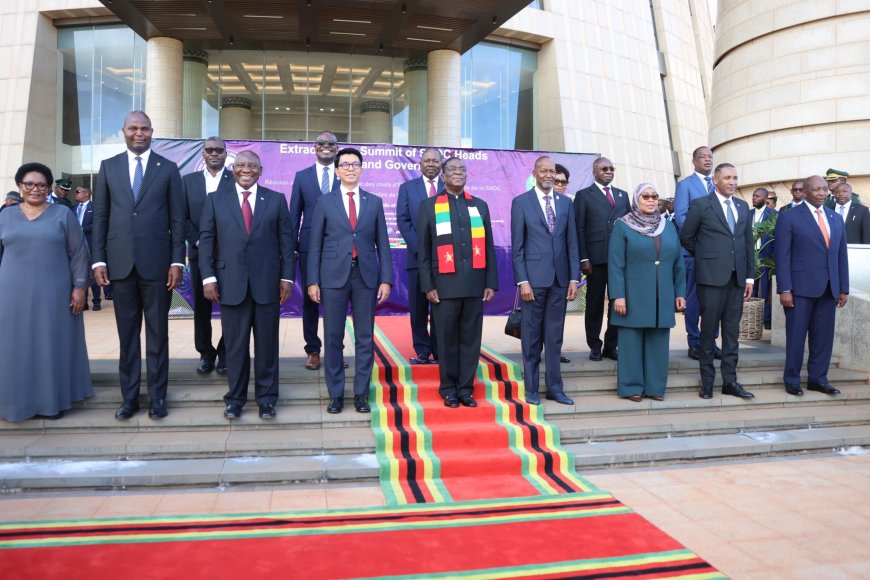
Durban — His Excellency President Dr Emmerson Dambudzo Mnangagwa arrived in Durban, South Africa, yesterday to participate in the 46th Ordinary Summit of the Southern African Development Community (SADC) Heads of State and Government, set to open today, August 17, at the Durban International Convention Centre.
The President touched down at King Shaka International Airport, where he was received by South Africa’s Deputy Minister of International Relations and Cooperation Thandi Moraka, Zimbabwe’s Minister of Foreign Affairs and International Trade, Professor Amon Murwira and Zimbabwe’s Ambassador to South Africa, Lovemore Mazemo.
South Africa prepares to formally assume the SADC Chairmanship after holding the position on an interim basis following the withdrawal of Madagascar due to a domestic political crisis following the overthrow of Andry Rajoelina.
Posting on his official X account shortly after arrival, President Mnangagwa reaffirmed Zimbabwe's commitment to regional integration.
“I have safely arrived in Durban, South Africa, to participate in the 46th Ordinary Summit of Southern African Development Community (SADC) Heads of State and Government," he said.
"This year, our region gathers under a pivotal theme: ‘Resilient, Sustainable and Inclusive Industrialisation through Infrastructure Development, Agricultural and Critical Minerals Transformation in Pursuit of a Just World.’
"Zimbabwe remains deeply committed to driving regional integration. We look forward to fruitful deliberations that unlock the full potential of our shared infrastructure, agriculture, and vast mineral wealth.
"Together, we are building a stronger, self-sustaining SADC ecosystem that leaves no one and no place behind," said President Mnangagwa.
The summit comes as the regional bloc marks 34 years since the transformation of the Southern African Development Coordination Conference into SADC on 17 August 1992 in Windhoek, Namibia.
South Africa, which has held the chairmanship on an interim basis following political developments in Madagascar, will today take up the substantive leadership under President Cyril Ramaphosa.
The gathering is expected to provide strategic direction on accelerating regional integration, consolidating peace and security, advancing industrialisation, enhancing food security, driving the energy transition and promoting sustainable economic development across the 16-member community.
Authorities say Zimbabwe’s participation is anchored on four priority areas which are peace and security, industrialisation, infrastructure development and social and human capital development.
Foreign Affairs and International Trade Minister, Professor Murwira, who accompanied the President, emphasised the need for a coordinated regional approach to food production that leverages each country’s comparative advantages rather than every nation attempting self-sufficiency in isolation.
“For example, there are countries like Malawi, Tanzania and Madagascar which are very good at rice. We could have a rice programme," he said.
"There are countries like Zimbabwe which are very good at winter wheat. We could be focusing on this for food self-sufficiency,” Professor Murwira said.
He added that the region must reduce both tariff and non-tariff barriers to facilitate the free movement of agricultural products and other goods.
“We want to bring down trade barriers, both tariff and non-tariff trade barriers amongst ourselves," Professor Murwira said.
He further called for the establishment of common agricultural programmes, transboundary special economic zones and joint regional industrial projects as practical steps towards implementing SADC Vision 2050.
“It’s now time for implementation. Enough talk of policies, the policies are there,” he stated.
He stressed that agriculture must be viewed as a cornerstone of regional industrialisation because it supplies raw materials for processing industries while reducing dependence on imports.
Ultimately, he said, deeper integration should make the movement of people and goods seamless.
The success of SADC, he concluded, must be measured by tangible improvements in the lives of ordinary citizens.
The Ministry of Foreign Affairs and International Trade noted that the SADC region is moving from potential to production, from resources to value addition and from commitments to results.
President Mnangagwa is accompanied by Chief Secretary to the President and Cabinet Dr.Martin Rushwaya, Deputy Chief Secretary (Presidential Communications) George Charamba and Attorney-General Virginia Mabhiza.