
Manhivi's Big Dream Of Building A Business Through Eggs
By Dumisani Ndlovu — Oscar Manhivi, a former kombi driver behind Oscar Poultry Project, is building a poultry business with 440 layers and ambitions to empower his community.
 Dumisani Ndlovu
Gweru, Zimbabwe — What started as an ordinary livelihood behind the steering wheel of a commuter omnibus in one of the oldest suburbs of Gweru has evolved into an ambitious agricultural venture for Oscar Manhivi, a budding entrepreneur who is turning his passion for poultry farming into a promising business.
Trading as Oscar Poultry Project, Manhivi is demonstrating how ordinary people can rethink their financial priorities, embrace entrepreneurship and invest in ventures with the potential to generate sustainable income.
His journey from being a kombi driver to becoming a poultry farmer is not merely a change of occupation.
Manhivi revealed that it is a story of vision, calculated decisions and the determination to build something that can grow beyond its humble beginnings.
Rather than investing in a vehicle, Manhivi chose to put his money into an agricultural venture, believing that a productive investment would offer him better long-term prospects.
"Initially, I thought of buying a vehicle, but after having a second thought, I realised that investing in a business was the best way forward. Hence, this project," he said.
That decision marked the beginning of Oscar Poultry Project, an enterprise that is gradually taking shape through layer chicken farming.
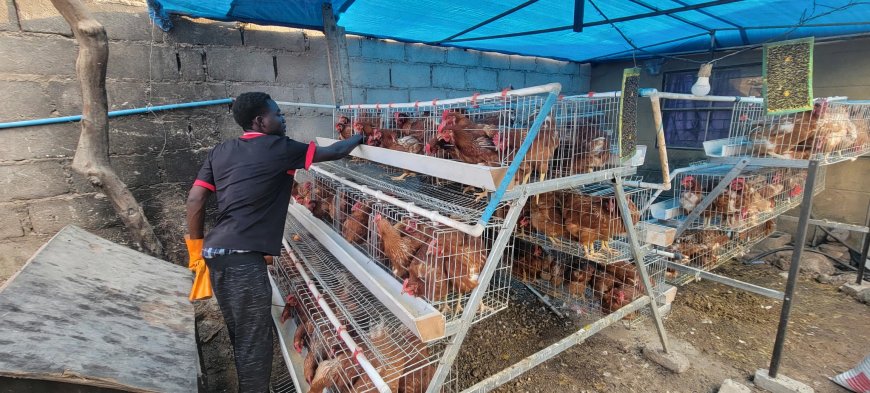
The project currently has 440 chickens specifically raised for egg production, commonly known as layers.
The birds are accommodated in a system comprising 96 layer chicken cages designed for egg-laying hens, allowing Manhivi to manage his flock within a structured production environment.
Despite being at an early stage of development, the project is already producing approximately seven crates of eggs per day, an encouraging output that reflects the potential of small-scale commercial poultry farming.
For Manhivi, however, the seven crates are only the beginning.
He hopes to increase production as the business grows, with access to additional land emerging as one of the key requirements for expansion.
His ambition is to move beyond the current production capacity and establish a larger poultry enterprise capable of meeting growing market demand.
The decision to focus on layers is significant because egg production offers farmers an opportunity to generate a relatively regular stream of income once their birds reach maturity and maintain consistent production.
Unlike enterprises that depend on occasional sales, layer farming creates the possibility of daily production and frequent market transactions.
However, he said maintaining such an operation requires careful attention to feeding, hygiene, disease prevention, housing and the general welfare of the birds.
Manhivi said the business demands consistency, discipline and patience.
Beyond the commercial prospects of selling eggs, Manhivi sees Oscar Poultry Project as an opportunity to contribute to economic empowerment within his community.
His vision is not limited to establishing a personal source of income as he hopes the project can eventually become a model of how small-scale agricultural ventures can create opportunities for others, particularly vulnerable members of society.
Manhivi believes that productive community-based projects can help people move away from dependency towards greater financial independence.
"It is my hope that this project will build independence among vulnerable groups in my community," he said.
He believes that backyard poultry farming, when properly organised and supported, has the potential to become more than a supplementary household activity.
Instead, it can develop into a sustainable livelihood, providing income, supporting household nutrition and strengthening the economic resilience of communities.
His thinking resonates with broader national aspirations under Zimbabwe's Vision 2030, which seeks to transform the country into an upper-middle-income economy.
Agriculture remains an important pillar in that ambition, particularly through initiatives that encourage productivity, entrepreneurship, value addition and the participation of ordinary citizens in economic development.
While Oscar Poultry Project is an independently driven enterprise, its philosophy reflects the wider importance of grassroots economic participation.
Manhivi believes that empowering individuals with productive opportunities can have a ripple effect, benefiting households and communities.
He described small-scale agricultural ventures as potential instruments of grassroots economic transformation, arguing that even modest investments can produce meaningful results when supported by the right resources and business approach.
"It is my hope that small backyard projects can scale into thriving businesses that uplift entire communities," he said.
Manhivi's entrepreneurial journey has also been shaped by encouragement and mentorship from people within his community.
He particularly acknowledges his former teachers, Leonard Masvanhisi and Mrs Masvanhise, who are also his neighbours, for the role they have played in encouraging and supporting him.