SADC Backs Zimbabwe’s UNSC Role, Renews Call for Sanctions Removal
SADC has backed Zimbabwe’s 2027-2028 United Nations Security Council tenure and renewed its call for the removal of sanctions, while pushing regional industrialisation, agricultural transformation and economic integration.
 Delicious Mathuthu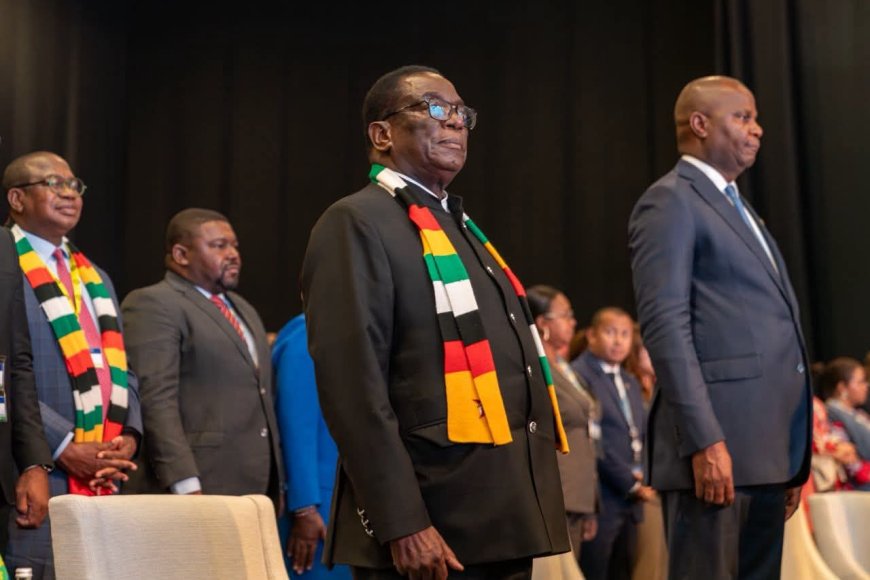
Durban, South Africa — The Southern African Development Community (SADC) has reaffirmed its strong backing for Zimbabwe as the country prepares to take up its seat as a non-permanent member of the United Nations Security Council (UNSC) for the 2027-2028 term, while renewing its call for the removal of sanctions imposed on Harare.
The regional bloc said it was confident Zimbabwe would use its position on the UN’s premier peace and security body to advance the interests of SADC, Africa and the Global South.
The position was adopted at the 46th Ordinary Summit of SADC Heads of State and Government held in Durban on Monday, August 17, where regional leaders also reiterated their solidarity with Zimbabwe and said the sanctions continued to constrain the country’s economic potential.
“[The] Summit congratulated the Republic of Zimbabwe on its election as a Non-Permanent Member of the United Nations Security Council (UNSC) for 2027-2028 term and expressed confidence in Zimbabwe’s ability to advance multilateral cooperation, promote international peace and security, and effectively represent the interests of the SADC region, Africa, and the Global South within the UNSC,” the SADC Secretariat said in its communiqué after the summit.
The regional endorsement comes ahead of Zimbabwe’s two-year tenure on the Security Council, where it will participate in deliberations and decisions on international peace and security.
SADC used the summit to again call for the removal of sanctions imposed on Zimbabwe, maintaining that the measures were limiting the country’s ability to realise its full economic potential.
“[The] Summit reiterated its long-standing call for the removal of sanctions imposed on the Republic of Zimbabwe, highlighting that the sanctions continue to limit the Republic of Zimbabwe from attaining its full economic potential,” the communiqué said.
The sanctions issue remains a major feature of Zimbabwe’s regional and international diplomatic engagement, with SADC repeatedly calling for their removal.
The Durban summit, chaired by South African President Cyril Ramaphosa, brought together Heads of State and Government and representatives from across the region, including President Emmerson Mnangagwa.
President Ramaphosa was elected Chairperson of SADC, while Zambian President was designated as the incoming Chairperson.
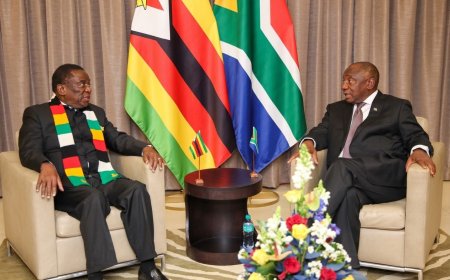
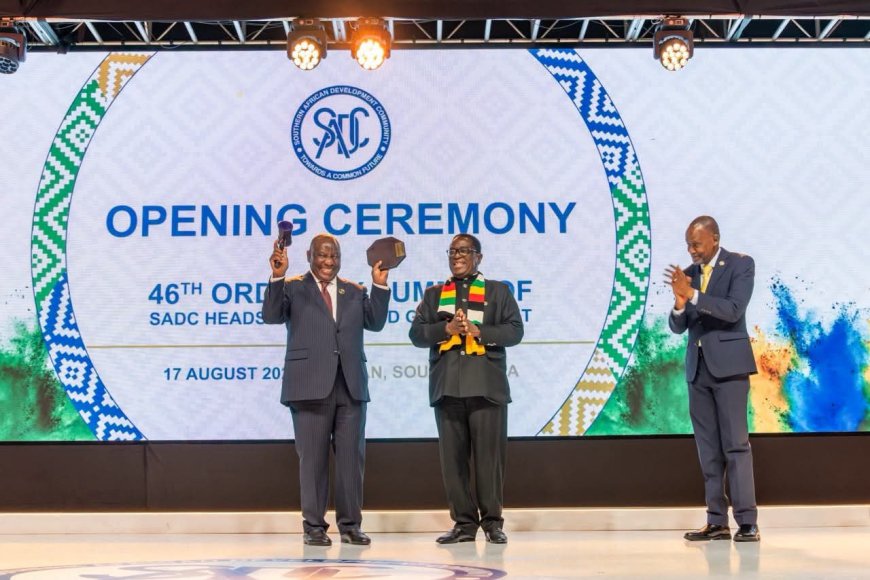 Incoming substantive SADC Chair, President Cyril Ramaphosa of South Africa and outgoing Chair, Zimbabwe President Emmerson Mnangagwa at the 46th SADC Summit in Durban. Photo credit: SADC Secretariat.
King Mswati III of Eswatini was elected Chairperson of the Organ on Politics, Defence and Security Cooperation.
The summit also assessed political and security developments in the region, with the Democratic Republic of Congo, Madagascar and Mozambique featuring prominently in discussions.
On the DRC, SADC reiterated its solidarity with the people of the country and reaffirmed support for coordinated regional and international efforts to restore peace and security.
The bloc said the response should include protection of civilians, strengthened humanitarian and public health measures, inclusive dialogue and greater resilience to the continuing challenges confronting the country.
In Madagascar, SADC welcomed constructive engagement facilitated by the SADC Panel of Elders, the Mediation Reference Group and the SADC Secretariat.
The regional bloc reaffirmed its commitment to supporting Madagascar’s reform process and development agenda, including inclusive governance, democratic institutions, accountability, human rights and citizen participation.
SADC also urged stakeholders in Madagascar to preserve the relative calm prevailing in the country and “choose the path of dialogue to address their grievances.”
The summit commended Mozambique for its ongoing inclusive national dialogue and its continued efforts to combat terrorism and maintain peace and security in parts of Cabo Delgado Province.
It also commended President Daniel Chapo for inaugurating the SADC Regional Fisheries Monitoring, Control and Surveillance Coordination Centre in Maputo in June.
The centre is mandated to combat illegal, unregulated and unreported fishing, a challenge that continues to affect the region’s marine resources.
Migration was also placed on the regional agenda, with SADC calling for a coordinated and multidimensional regional dialogue to address the underlying drivers of migration.
The bloc said such an approach was necessary to develop “comprehensive, sustainable, and effective responses” to migration challenges.
Health security also featured prominently, with SADC urging Member States to strengthen disease surveillance and preparedness to prevent, detect and respond to outbreaks and pandemics.
The bloc called for continued regional support to the DRC in responding to the Ebola outbreak and commended Angola, South Africa and Zimbabwe, together with the Africa Centres for Disease Control and Prevention, the World Health Organisation and other partners, for providing financial and technical assistance towards the response.
SADC further noted regional efforts to control and prevent Foot and Mouth Disease and designated the Botswana Vaccine Institute as a regional Foot and Mouth Disease antigen and vaccine bank.
The move is expected to strengthen collective regional capacity to prevent and control future outbreaks.
Beyond political and security matters, the summit placed strong emphasis on economic integration and industrialisation, urging Member States to take advantage of emerging opportunities in the changing global geopolitical and economic environment.
The bloc called on countries to deepen regional integration, strengthen trade and investment, mobilise domestic resources, and strengthen collective resilience in pursuit of sustainable development.
Agriculture emerged as another major priority, with SADC urging Member States to increase regional trade in agricultural products by removing non-tariff barriers, harmonising standards and improving cross-border logistics.
SADC said the measures are intended to facilitate the movement of food commodities from surplus areas to deficit markets and help stabilise supplies and prices across the region.
The bloc also urged member States to strengthen preparedness for anticipated El Niño-induced climate shocks through improved early warning systems and drought preparedness measures.
It called for greater adoption of climate-smart agriculture, including irrigation development and drought-tolerant crop varieties.
The emphasis on climate resilience comes as SADC seeks to strengthen regional food security and reduce the impact of recurring droughts and other climate-related shocks on agricultural production.
The summit also received the mid-term review of the Regional Indicative Strategic Development Plan 2020-2030, which recommended a sharper focus on high-impact regional priorities.
These include industrialisation, resource mobilisation, regional value chains, agro-processing, critical minerals, just energy transition, economic corridors, one-stop border posts and health financing.
SADC subsequently endorsed a new summit theme: “Resilient, Sustainable, and Inclusive Industrialisation through Infrastructure Development, Agricultural and Critical Minerals Transformation in Pursuit of a Just World.”
The theme identifies infrastructure, agriculture and critical minerals as key drivers of industrialisation and the creation of a competitive, climate-resilient, inclusive and prosperous regional economy.
The bloc also approved the agreement establishing the SADC Tourism UNIVISA and called on member States to sign it.
SADC said the initiative would facilitate seamless travel across the region, promote tourism growth, deepen regional integration and support economic development through increased visitor arrivals and investment.
The summit further urged member States to expedite the signature and ratification of SADC legal instruments that have been adopted but are yet to enter into force, saying stronger implementation would accelerate regional integration and cooperation.
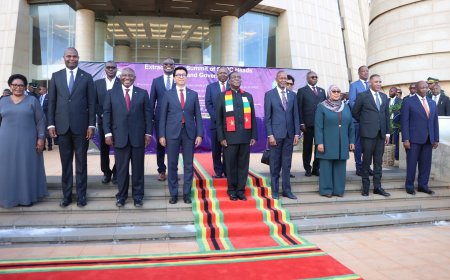
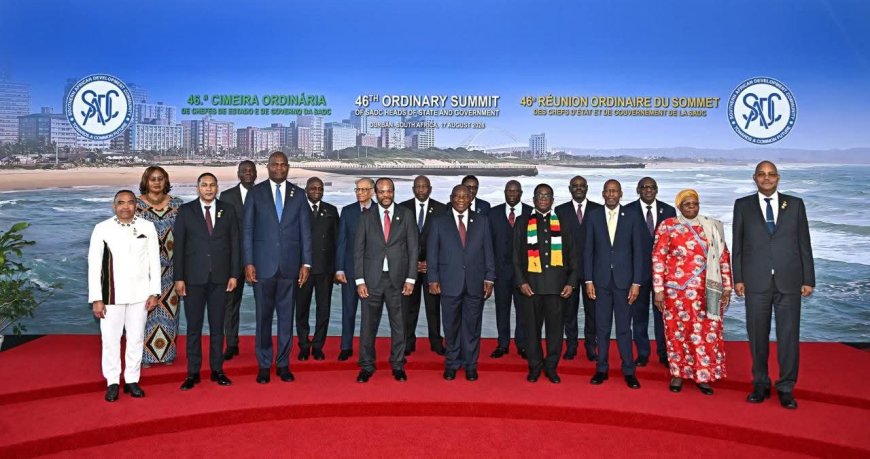 SADC Heads of State and Government at the 46th SADC Summit in Durban, South Africa. Image credit: SADC Secretariat.
In the area of preventive diplomacy, former Botswana President Dr. Mokgweetsi Masisi and former Mozambican President Dr. Joaquim Chissano were appointed members of the SADC Panel of Elders to support mediation, conflict prevention and preventive diplomacy in the region.
SADC also welcomed Angola’s invitation to regional leaders to participate in an Extraordinary African Union Summit on strengthening mechanisms for conflict prevention and resolution in Africa, to be held in Luanda from August 29 to 30.
The regional bloc also commended South Africa for successfully hosting the ninth annual SADC Industrialisation Week and Exhibition in Durban from July 26 to 31 and welcomed its declaration calling for stronger regional industrial value chains.
The declaration is seeking to increase production, value addition, intra-SADC trade and industrial competitiveness.
President Mnangagwa was also commended for his contribution to regional integration and economic development during his tenure as an outgoing member of the SADC Troika.
“[The] Summit commended His Excellency Dr. Emmerson Dambudzo Mnangagwa, President of the Republic of Zimbabwe and Outgoing Chairperson of SADC for his unwavering support and commitment towards advancing regional integration and economic development in the SADC region during the interim period as a member of the SADC Troika,” the communiqué said..
The 46th Summit concluded with SADC expressing appreciation to South Africa for hosting the meeting, while Zambia was confirmed as host of the 47th SADC Summit of Heads of State and Government.