Manhize steel plant urged to anchor Zimbabwe’s industrial revival
Government has urged industry players to leverage the US$1.5 billion Manhize steel project to expand value chains, create jobs and accelerate Zimbabwe’s industrialisation.
 Dumisani Ndlovu
Mvuma — Government has challenged industry players to build stronger linkages around the Dinson Iron and Steel Company (DISCO) Manhize project as Zimbabwe seeks to accelerate industrialisation, value addition and import substitution.
Industry and Commerce Minister Nqobizitha Mangaliso Ndlovu made the call during a stakeholders’ engagement and tour of the US$1.5 billion Manhize steel plant in Mvuma, Midlands Province, where government, manufacturers, academics and other players in the iron and steel value chain discussed opportunities and challenges facing the sector.
The engagement was attended by captains of industry and representatives of organisations including ZISCO Steel, RBM Bus Manufacturing and other companies seeking to establish linkages with DISCO.
Minister Ndlovu said the engagement followed discussions he had held with DISCO management in China on the need for Zimbabwean companies to deepen upstream and downstream linkages around the Manhize investment.
He said the objective was to ensure the giant steel project did not operate in isolation, but became the foundation for a wider industrial ecosystem.
“This company did not think twice. They said this is a noble story. Let us shape it together,” Ndlovu said, recounting discussions with DISCO management.
He said government wanted the iron and steel sector to work collectively to transform Zimbabwe into a stronger industrial economy.
The minister said the engagement was also informed by a directive from President Emmerson Mnangagwa for industry to find ways of working together to build the economy around Zimbabwe’s mineral resources.
The government has identified iron and steel value chains as important to its industrialisation and beneficiation ambitions. Recent official and industry reports have also highlighted the Manhize project as a major driver of the revival of Zimbabwe’s steel industry and the country’s shift towards regional exports.
Speaking on behalf of the Midlands Minister of State for Provincial Affairs and Devolution, Dr Edgar Senza welcomed the Industry and Commerce Minister and his delegation, describing DISCO as a major manifestation of the Government’s industrialisation drive.
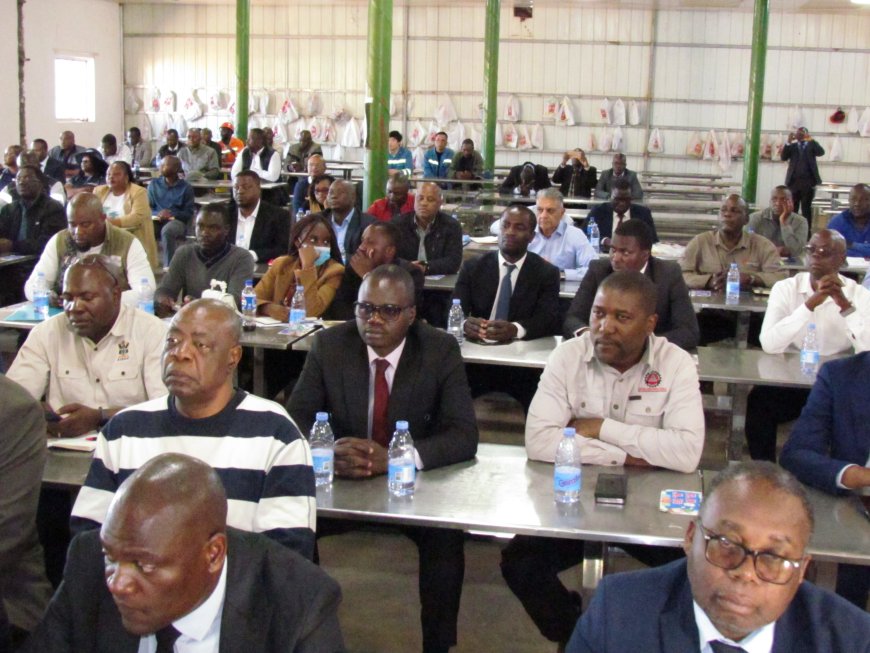
Stakeholders from the steel manufacturing sector attentively listen to Minister Ndlovu during the meeting.
He said the approximately US$1.5 billion investment had the potential to transform Manhize from a steel-producing site into an integrated industrial and manufacturing hub.
According to Senza, the project was aligned with the national drive towards mineral beneficiation, value addition, import substitution, investment mobilisation and employment creation.
He said the development of linkages between DISCO and other steel-related companies would be critical in creating integrated value chains rather than isolated industrial investments.
Of particular significance, he said, was the 800-hectare DISCO Special Economic Zone, which has attracted interest from more than 300 companies seeking opportunities in areas including pipe manufacturing, nails, roofing materials, fabrication and the utilisation of slag and ash.
“Our aspiration is to see Manhize develop beyond a steel-producing location into a fully integrated industrial and manufacturing hub, attracting local and foreign investors, developing SMEs, creating specialised skills and generating employment,” Senza said.
He said DISCO was already supporting more than 1,300 direct jobs and more than 3,000 indirect jobs, with employment expected to increase as additional phases of the project come on stream.
DISCO management, however, put its current direct employment figure at more than 2,000 workers.
Addressing the stakeholders, DISCO representative Shumba said the company had moved beyond the construction phase and was now focused on building an industrial ecosystem around the Manhize project.
He said the company began production in 2024 and was now producing a range of steel products, including billets, wire rods, mill balls and reinforcement bars.
He said about 40 percent of DISCO’s steel output was being sold locally, while the remaining 60 percent was being exported to neighbouring countries in the region.
Shumba said the company had also recorded a significant increase in value-added steel exports during the first half of 2026.
The figures presented at the meeting come against a broader increase in Zimbabwean steel exports, with Minerals Marketing Corporation of Zimbabwe data showing that steel exports reached US$92.1 million from 146,314 tonnes in 2025.
The company said it was also expanding its operations beyond steel production, with a 400,000-tonne-per-year cement plant expected to begin production in October.
The cement project will use blast-furnace slag, a by-product of steel production, in what the company described as an effort to promote circular economy principles.
DISCO also said it had established a captive power generation facility with more than 70MW of capacity, comprising thermal generation and waste-heat recovery, while plans were underway to add solar power.
The company said the Manhize investment was creating opportunities for skills development, particularly among young people and women, through in-house training and partnerships with technical colleges and universities.
However, DISCO urged government to address several challenges that it said were affecting the competitiveness and expansion of the project.
Among the issues raised were the classification of steel as a mineral product, land tenure within the Special Economic Zone, approval of a planned industrial city adjacent to the plant, high logistics costs and the absence of a dedicated railway solution.
The company also raised concerns over tariff barriers imposed by neighbouring countries and what it described as duplicated land-related charges payable to different government institutions.
DISCO called for a streamlined regulatory framework and longer-term land security, including a title deed, to support future investment.
Shumba said the company was raising the issues as a partner seeking solutions rather than as complaints.
“We are building a steel city, not just a plant,” he said, outlining a vision of an industrial ecosystem incorporating downstream industries and other businesses.
Permanent Secretary in the Ministry of Industry and Commerce Ambassador Tadeous Chifamba said government was prepared to facilitate continued dialogue among companies across the iron and steel value chain.
He said the ministry wanted private-sector players to identify practical challenges and work together on solutions capable of advancing Zimbabwe’s Vision 2030 objectives.
“We have a lot of work to do,” Chifamba said, adding that the ministry would facilitate value-chain dialogue to ensure industrial investments generated wider economic benefits.
Minister Ndlovu said the stakeholder meeting was deliberately structured to bring together different players who could benefit from the steel being produced at Manhize.
He said the government wanted local companies to take advantage of opportunities created by DISCO rather than allowing the investment to remain a standalone operation.
The minister also said stakeholders who had not previously toured the plant would be given an opportunity to see the operations first-hand, with the tour organised in groups because attendance had significantly exceeded the initial expectations.
The Manhize project has been described as one of Zimbabwe’s largest industrial investments in decades and a key component of efforts to revive the country’s heavy industry. The first phase has a reported production capacity of about 600,000 tonnes annually, with subsequent phases expected to increase capacity substantially.
For government, the central challenge now is to ensure that the steel produced at Manhize becomes a catalyst for a broader manufacturing revival — creating companies, jobs, skills, exports and downstream industries across Zimbabwe.
The minister said the engagement marked the beginning of continued dialogue between government and industry players.
He said the success of the Manhize investment would ultimately depend on how effectively Zimbabwean companies could connect to the project and convert locally produced steel into finished goods and wider industrial opportunities.