Zimbabwe at 46: President Mnangagwa Challenges Youth to Secure the Nation’s Future
At the 46th Independence Day Children’s Party in Maphisa, President Emmerson Mnangagwa called on over 3,000 students to move beyond the classroom and embrace science, innovation, and national unity as the new frontier of Zimbabwean independence.
 Dumisani Ndlovu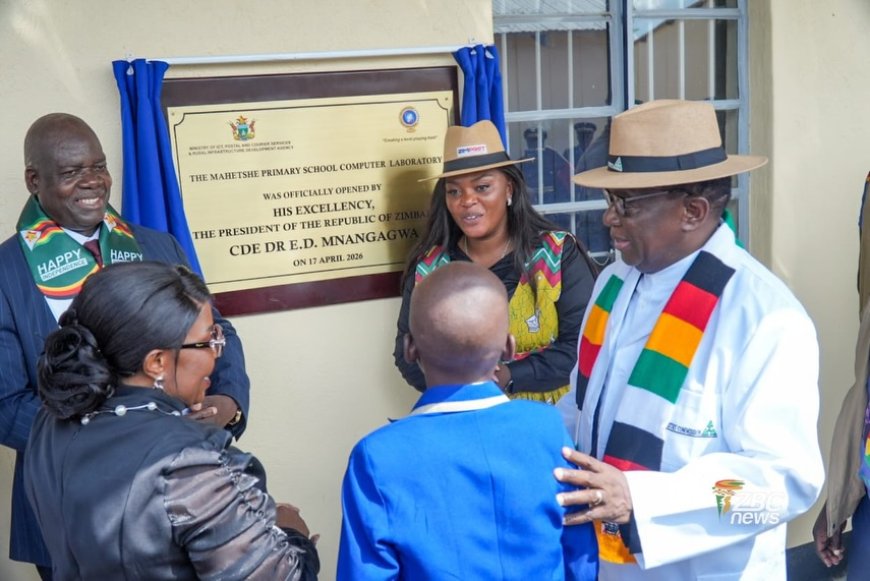
Maphisa, Matabeleland South - There are moments in the life of a nation when ceremony gives way to something deeper, and symbolism yields to introspection. Zimbabwe’s 46th Independence Day Children’s Party at Mahetshe Primary School was one such moment, a quiet reckoning staged in the faces of 3,050 children drawn from every corner of the republic.
They had arrived as delegates. They left as witnesses.
At the centre of the gathering stood Zimbabwe President, Emmerson Mnangagwa. He appeared not merely as a Head of State, but as a man asking a generation not yet burdened by history to consider the gravity of their inheritance.
Before the President spoke, the task of introduction fell to Torerayi Moyo, the Minister of Primary and Secondary Education. What followed was no ordinary protocol but a biography deliberately framed as instruction.
He spoke of a boy from the Midlands and a classroom at Lundi Primary School in Shurugwi. He traced a journey that stretched into Zambia and eventually into the harsh corridors of Khami Maximum Security Prison.
There, incarcerated between 1965 and 1975, a young Mnangagwa began studying law under conditions designed to break the human spirit.
"No situation is too difficult to overcome," Minister Moyo told the assembled children. In that telling, the President was no longer a distant political figure but a life translated into a lesson.
When President Mnangagwa rose to speak, he moved quickly past the formalities of the "Zimbabwe at 46" banner. He went straight to the foundational cost of the nation.
"This independence we are enjoying did not come on a silver platter," he said.
He then paused, before offering a pivot that shifted the atmosphere of the school grounds.
"You, the children of today, are you ready to sacrifice your lives for the independence of our country?" He asked.
The response was immediate and deafening. "Yes!"
It was a moment both electrifying and unsettling, a generational echo of a war the children know only through textbooks. The President did not soften the history. He reminded them that children had died and others had been injured in the struggle.
Independence, he noted, had been paid for in youth, a currency not unlike the youth gathered before him. He invoked the names of Matabeleland South’s own icons, Joshua Mqabuko Nkomo and Jason Ziyaphapha Moyo, figures whose legacies hover between reverence and responsibility.
If the past framed the question, the present defined the task. Unity, the President insisted, is not a passive inheritance but a discipline. In a gathering that physically assembled Zimbabwe in miniature, various provinces, languages and backgrounds, he saw a specific design.
"We are one people," he said, "Love your country when you are awake and when you dream."
It was a poetic, almost intimate appeal, yet remained anchored in a difficult political truth; that unity, once fractured, is arduous to restore. In a country that has known its share of internal fractures, the words carried a distinct weight.
The President’s message however sharpened most when discussing the future of the Zimbabwean classroom. He suggested that schools must become engines of innovation rather than mere sites of instruction.
"I do not want you to merely speak good English," he told the students, "I want you to create."
He spoke of science, innovation and critical thinking as tools of survival in a global economy where knowledge is the primary currency.
The message was not rhetoric or detached from policy. Across the country, 40 Presidential Science Laboratories now stand as physical manifestations of the ambition, alongside digital platforms aimed at reaching isolated communities.
Yet, with this digital access comes new risks.
"Parents and educators have a duty to guide," he cautioned, acknowledging the double-edged nature of modern technology.
Turning to the soil, he spoke of school-based business units, production aimed not just at sustenance, but at export. In that vision, education is not a preparation for life but life already in motion.
Perhaps the most striking thread running through the day was the implication that independence is an unfinished project.
"Now it is your turn," the President told the children. Their task, he argued, was not to fight a war, but to modernise and industrialise a nation, to carry forward a promise they did not negotiate, but must now fulfil.
It is a heavy ask for young shoulders. Yet, as the children responded in unison, it revealed the enduring power of belief in the process of nation-building.
As the programme drew to a close and the familiar rhythm of independence choreography resumed, a question lingered. Was this a ceremonial exchange destined to fade with the music? Or was it the beginning of a new intergenerational contract, spoken not in policy documents, but in a collective "yes"?
On a cool April day in Maphisa, beneath wide Matabeleland skies, Zimbabwe looked at itself through the eyes of its children.
For a brief moment, the future did not feel distant. It felt present.