Mbirimi’s Community-Driven Investment Transforms Rural Learners
 Dumisani Ndlovu
SHURUGWI – In a constituency where poverty has long dictated the limits of a child’s education, a privately funded bursary scheme and targeted community investments are quietly reshaping futures for learners, parents and schools alike.
Across several wards in Shurugwi South, communities are applauding an education intervention by local farmer and businessman Rodwell Mbirimi, describing it as a lifeline for vulnerable learners who were on the brink of dropping out due to escalating school fees and household hardship.
The bursary targets academically gifted learners from impoverished backgrounds and removes the financial barriers that routinely derail rural education. More than ten learners have already been enrolled at boarding schools, with full support covering tuition, uniforms, textbooks, toiletries and boarding fees.
Unlike donor-funded programmes or government schemes such as the Basic Education Assistance Module (BEAM), the initiative is financed entirely through private resources. Community leaders say this independence has strengthened trust, predictability and accountability, particularly in an environment where delays and exclusions have often undermined public assistance programmes.
For parents, the impact has been immediate and deeply personal.
Agness Mutero, a parent from Debshan, said her daughter’s education had reached a dead end before the bursary intervention.
“We had reached a point where we thought our child’s education was over,” she said. “School fees were impossible for us. When Mr Mbirimi stepped in and paid everything, it felt like a burden had been lifted. My child is now in boarding school—warm, fed and learning. This has changed our family’s future.”
Beyond individual households, communities say the scheme has restored dignity and hope at a collective level. In Dorset Resettlement Area, villagers praised the transparent and consultative beneficiary selection process, which involves village elders and school administrators.
“There is no favouritism,” said one community elder. “We sit together as a community and agree on who needs help most and who is performing well academically. That is why people trust this programme.”
Residents in Donga, Mukandapi, Rusununguko and surrounding areas echoed similar sentiments, noting that rising education costs had pushed many learners—particularly girls—out of school before the bursary offered relief.
“When you educate a girl, you educate a nation,” said Siphosami Ndlovu, a community member. “This initiative is not only keeping girls in school, it is changing how families and communities think about the value of educating daughters.”
Among the beneficiaries is Lorah Mangondoza, a former Dorset Secondary School learner who passed her O-Level examinations with flying colours despite severe financial constraints. Today, she is studying Arts at Mtshabezi High School—an opportunity her family once considered unattainable.
“I never thought I would study at a boarding school,” Mangondoza said. “This support has given me confidence. I feel seen and valued. I want to use my education to inspire other girls from rural areas who think their dreams are too big.”
Her journey mirrors that of other Lower Six beneficiaries who have transitioned from rural day schools to established boarding institutions. Precious Ndabambi, formerly at Mupangayi High School, is now studying Arts at Mzingwane High School. Amellisa Tumba, previously at Rusununguko High School, has enrolled at Mtshabezi High School to pursue Sciences, while Trinity Sibanda, formerly of Batanai Secondary School, is pursuing Sciences at Mzingwane High School.
Ndabambi said the sponsorship had altered how she viewed herself and her future.
“This opportunity allows me to dream bigger and work harder,” she said. “Knowing that someone believes in you makes a difference.”
School authorities say the impact of the bursary extends beyond academic access, reducing anxiety among learners and stabilising school attendance.
“This kind of assistance removes fear and uncertainty,” said one school head. “Learners focus on learning instead of worrying about fees, while parents regain confidence that their children will complete school.”
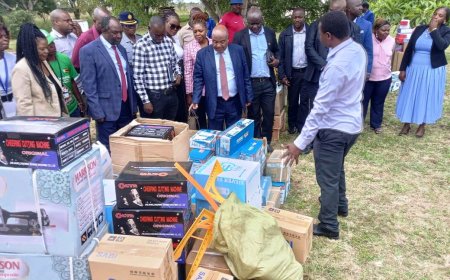
The education support has been reinforced by broader community investments. Of late, Mbirimi drilled a borehole at Rusununguko High School, furnished Zvamavande Rural Clinic, and recently donated 12 public address system units valued at US$2 400 and 12 printers valued at US$1 920 to schools and community institutions during his invitation as Guest of Honor at schools Speech and Prize Giving days .
Education officials say the equipment has strengthened communication, administration and programme delivery in resource-constrained rural settings.
“These are not cosmetic donations,” said a ward 21 opinion leader, Patricia Patiwa. “We thank Mbirimi to the utmost for honouring his word. He pledged to support vulnerable but brilliant pupils who will pass. Now he has honoured his promises.He is not like other sons and daughters of Shurugwi who make false promises. The Starlink and public adressing system he donated at Dorset Secondary School directly improve how schools function on a daily basis,”said Patiwa.
In 2026, Mbirimi honoured a pledge to fully support learners who demonstrate academic excellence despite difficult circumstances—an undertaking community leaders say has restored confidence among vulnerable households.
“He has proven that this is not about politics or publicity,” said a local school head. “It is about giving children a fair chance to succeed.”
In a recent constituency development update, the Shurugwi South Member of Parliament commended Mbirimi and other local stakeholders for supporting education and community development, calling for unity in building locally driven solutions.
As the bursary scheme and complementary investments continue to reshape access to education, communities say their true value lies in the ripple effects—relieved parents, empowered learners, strengthened schools and a renewed belief that sustainable development can begin at home.
In Shurugwi South, futures are being quietly rewritten—one learner, one family and one opportunity at a time.