Amateur Astronomers Honored for Discovery of 100 Exoplanets and Anomalous Planetary Ring
The Astronomical Society of Australia has awarded the 2026 Page Medal to backyard observers whose verification of distant worlds and discovery of a rule-breaking ring around dwarf planet Quaoar have challenged existing celestial theories.
 Harry Taruva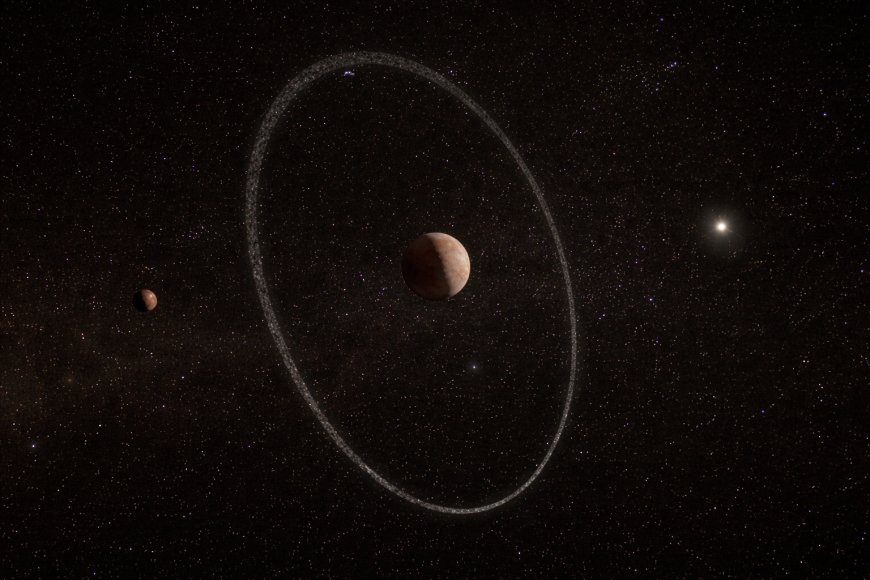
Tamworth - A group of amateur astronomers who transitioned from Apollo-era inspiration to professional-grade discovery have been honored with Australia's prestigious Page Medal for their contributions to global space research.
The recipients, based in Gippsland, Brisbane, and the Gold Coast, were recognised by the Astronomical Society of Australia (ASA) for identifying over 100 distant planets and discovering a planetary ring that defies current gravitational theories.
Their work has provided critical data used to guide the operations of multi-billion-dollar instruments, including NASA’s James Webb Space Telescope.
Among the honorees is Chris Stockdale, an IT professional from Gippsland who has co-authored more than 100 planet discovery papers.
Operating from a backyard observatory, Stockdale specialises in validating "transits", the minute dip in light that occurs when a planet passes in front of its host star.
"I first got a taste for space during Apollo. We were living on a farm with dark skies where my dad showed me a comet, which I watched and sketched from day to day," Stockdale said.
Stockdale acts as a vital "human in the loop" for NASA’s Transiting Exoplanet Survey Satellite (TESS).
By using his A$100,000 automated setup to confirm potential candidates identified by the satellite, he ensures that high-priority targets are ready for atmospheric analysis by larger international facilities.
His portfolio includes the co-discovery of an "ultra-hot Neptune" and several potentially Earth-like worlds.
The medal was also awarded to Jonathan Bradshaw and Renato Langersek, who, alongside veteran observer John Broughton, became the first amateur astronomers to discover a planetary ring.
The ring circles Quaoar, a dwarf planet roughly half the size of Pluto located on the outskirts of the solar system.
The discovery has proved an enigma for physicists because the ring sits 4,000 kilometers above Quaoar, well beyond the "Roche Limit."
According to established theory, tidal forces at that distance should be too weak to prevent the ring material from coalescing into a moon.
"The star blinked before and after Quaoar passed in front of it. Renato, John and I all saw it, so we knew it wasn’t a glitch," Bradshaw said.
"The best explanation was that there was a ring. It was an enigma because it is much further from Quaoar than expected," he said.
The discovery, originally published in the journal Nature, has triggered international collaboration.
Renato Langersek noted that the find resulted in an "avalanche of interest," leading to invitations to participate in observation events with NASA in the Northern Territory and across North America.
Professor Richard McDermid, President of the ASA, said the achievements of these backyard astronomers demonstrate that dedicated individuals can make profound impacts on the scientific understanding of the cosmos.

"Their observations can guide the work of billion-dollar telescopes," added Dr. Tanya Hill, ASA prizes coordinator.
The Page Medal, inaugurated in 1972, is awarded every two years to recognise excellence in amateur astronomy that serves to advance the field. The 2026 honors were presented during the National Australian Convention of Amateur Astronomers in Tamworth on April 4.