Coding the Future: Inside Gweru’s Quiet AI Revolution
In Gweru’s Memorial Library, a grassroots digital literacy programme is set to reshape how communities engage with modern technology. Spearheaded by the Zimbabwe Information and Technology Empowerment Centre (ZITEC) under Dr. Nancy Kwangwa, the initiative equips citizens with practical skills in data use, ethics, and digital protection.
 Dumisani Ndlovu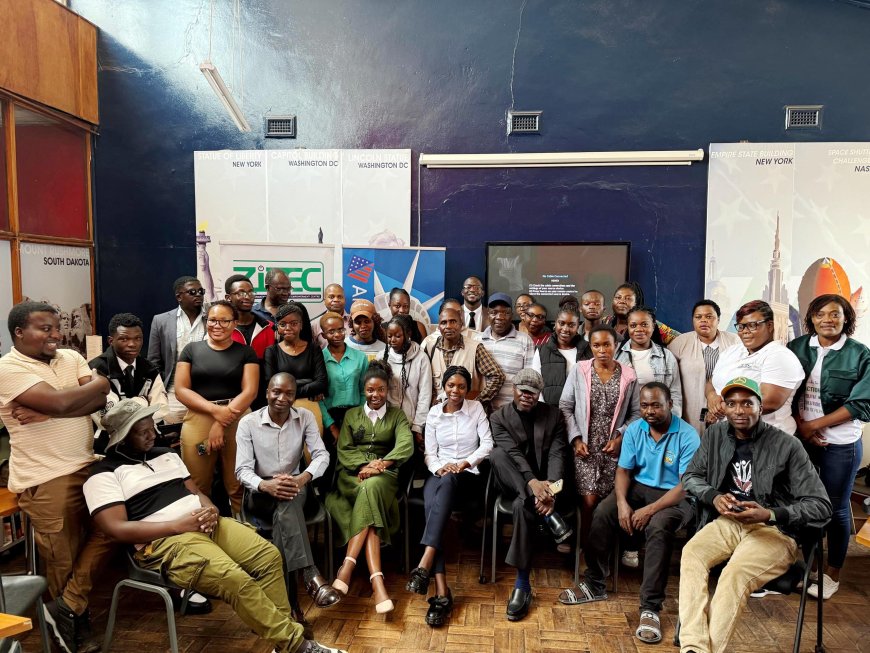
In a modest Memorial Library training room in Gweru, the future is being written—not in ink, but in algorithms, ideas, and ambition.
Rows of young people and professionals lean forw
ard, eyes fixed on glowing screens, their conversations punctuated by terms that until recently felt distant: machine learning, digital ethics, data protection. But here, they are no longer abstract concepts. They are tools—tools to solve real problems, in real communities.
This is the frontline of Zimbabwe’s emerging artificial intelligence movement. At the centre of it is the Zimbabwe Information and Technology Empowerment Centre (ZITEC), quietly spearheading a programme that is equipping citizens with the knowledge to not only understand AI, but to shape it. Leading the charge is Dr Nancy Kwangwa, whose vision is as practical as it is urgent: ensure that no Zimbabwean is left behind in the age of intelligent machines.
“We are not just teaching technology,” she says. “We are building capacity for community transformation.”
More Than a Workshop
On paper, it is an AI literacy training workshop. In reality, it is something far more consequential.
Participants are taught how to harness artificial intelligence to tackle everyday challenges—from improving service delivery to enhancing communication, from safeguarding digital identities to generating innovative solutions for local development. It is a hands-on, minds-on experience, where theory quickly gives way to application.And the numbers tell their own story.
In just two workshops held in Gweru, more than 100 people have already passed through the programme—each one leaving with a new set of digital competencies, and perhaps more importantly, a new way of thinking.
They are teachers imagining smarter classrooms. Entrepreneurs exploring data-driven business models. Youths discovering that they can build, not just consume, technology.
In a country where the digital divide remains a persistent challenge, that shift is profound.
The programme is not happening in isolation. It is anchored in the Zimbabwe National Artificial Intelligence Strategy 2026–2030, a blueprint that places people—skills, talent, and inclusion—at the heart of technological progress.
One of its core pillars is clear: AI literacy for all.
But strategies often live and die on paper. What is unfolding in Gweru is something different—the strategy in motion, translated from policy language into lived experience.
Here, AI is no longer the preserve of experts in distant labs. It is being localised, simplified, and democratised.
Workshops have already been held in Harare. Gweru is now hosting its second. And the programme is expanding beyond geography into sectors—schools, churches, and youth groups—recognising that technology does not exist in a vacuum.
“One size does not fit all,” Dr Kwangwa explains. “We customise our training because people come with different levels of digital skills. Inclusion is not just about access—it’s about relevance.”
Yet, amid the excitement, there is caution.
Because with power comes risk.
Artificial intelligence, if left unchecked, can amplify bias, erode privacy, and deepen inequalities. And so, woven into every session is a conversation about responsibility.
The programme draws from the UNESCO Global Recommendation on the Ethics of Artificial Intelligence, grounding participants in principles such as non-discrimination, accountability, and the imperative to “do no harm.”
These are not abstract ideals. They are practical safeguards.
In one exercise, participants are asked to interrogate the tools they use: Who built them? What data do they rely on? Who might be excluded? It is a moment of reflection in a space otherwise driven by innovation.
Because the goal is not just to create users of AI—but stewards of it.
Perhaps the most striking aspect of the programme is its philosophy: that technology must serve everyone.
ZITEC’s outreach extends to children, ensuring early exposure to digital skills. It reaches into religious spaces, where conversations about ethics and technology intersect. It adapts to educators, recognising their role as multipliers of knowledge.
This layered approach acknowledges a simple truth—AI will touch every sector of society. Preparing only a few is not enough.
And so the work continues, workshop by workshop, community by community.
There are no grand headlines announcing this shift. No billion-dollar investments or towering data centres.
Instead, there are rooms like this one in Gweru—filled with curiosity, questions, and possibility.
A young participant raises her hand, asking how AI can help address challenges in her community. Another sketches out an idea for a solution that did not exist for him just hours before.
These are small moments. But together, they form something larger.
A quiet transformation.
Because in the end, the true power of artificial intelligence does not lie in the machines themselves—but in the people who learn to use them, question them, and shape them.
And in Gweru, that future has already begun.