A Crown of Duty and Development: The Rise of the Fifth Chief Chiwundura
 Dumisani Ndlovu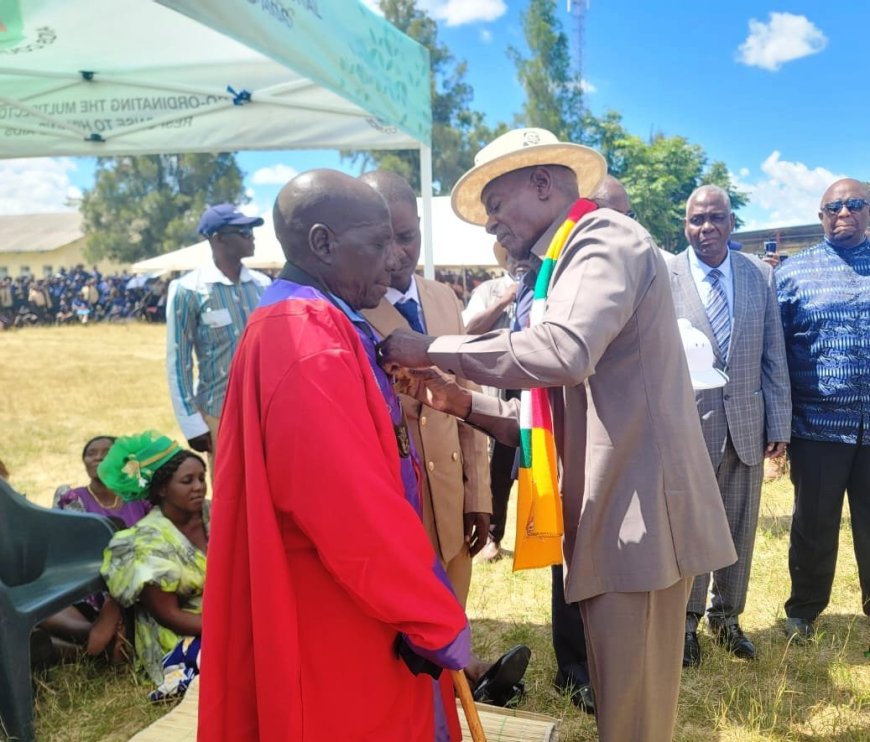
Chiwundura, Zimbabwe - The air at Gunde High School in Chiwundura was thick with anticipation long before the official motorcade arrived. Villagers — some draped in traditional regalia, others in their event best — gathered beneath the vast Midlands sky to witness what many described as a historic turning point: the formal installation of the fifth Chief Chiwundura.
Born Abedinico Tavengwa, the new traditional leader stepped into office amid ululation, rhythmic drumbeats and the solemn weight of expectation. His appointment by Emmerson Mnangagwa last year laid the constitutional foundation, but it was the collective hope of the Chiwundura community that gave Thursday’s ceremony its emotional gravity.
For many, the installation was not merely ceremonial — it symbolised renewal.
“This is a new chapter for us,” said one elderly villager, leaning on his walking stick as proceedings unfolded. “A chief is not just a custodian of tradition. He is the anchor of our development.”
The ceremony drew hundreds of villagers and senior government officials, underscoring the enduring relevance of traditional leadership structures in modern Zimbabwe. In a province where rural development, cultural preservation and environmental stewardship are deeply intertwined, the role of a chief remains both symbolic and practical — at once a guardian of heritage and a steward of progress.
Midlands Minister of State for Provincial Affairs and Devolution, Owen Ncube, reminded the newly installed leader that the chieftaincy carries a developmental mandate as much as a cultural one. He highlighted Zunde Ramambo — the traditional communal granary system — as a pillar of food security and solidarity, urging the chief to ensure that no household is left vulnerable.
“We rely on you for everything to do with development in your community,” he said. “Lead with fairness, respect and love.”
The message was echoed by the Minister of Local Government and Public Works, Daniel Garwe, who grounded the chief’s authority within the framework of the Traditional Leaders Act.
That law — formally known as the Traditional Leaders Act (Chapter 29:17) — is more than a statutory instrument gathering dust in government archives. It is the legal spine of Zimbabwe’s traditional governance system. The Act recognises chiefs, headmen and village heads under customary law, setting out how they are appointed, how they may be removed, and what authority they exercise within their jurisdictions.
In essence, it weaves ancestral legitimacy into constitutional order.Under its provisions, traditional leaders are entrusted with administering customary law, resolving disputes, promoting cultural values and preserving the extended family system. They are expected to work hand in hand with the State, conveying national programmes to the grassroots while articulating community concerns upward. The Act also outlines the support structures and resources provided by government, reinforcing the idea that traditional leadership is not ornamental — it is functional.
Its broader ambition is clear: to regulate traditional authority, promote good governance and ensure that chiefs are active participants in national development.
Yet beyond statutes and speeches, the true heartbeat of the day lay with the people.Younger villagers spoke passionately about roads awaiting rehabilitation, irrigation schemes needing expansion and schools seeking improved resources. In their chief, they see not only a custodian of ancestral wisdom, but also a bridge to government corridors and development agencies.
“We are in a massive development drive,” one villager said with conviction. “The installation of the Chief gives us more power to continue.”
That optimism comes at a time when government continues to amplify the role of traditional leaders as stewards of environmental conservation — particularly in rural provinces where land, forests and water sources form the backbone of livelihoods. In Chiwundura, where farming defines daily life, safeguarding the environment is inseparable from securing the future.
As part of his conditions of service, Chief Chiwundura received a vehicle — a practical instrument symbolising mobility, reach and authority. Yet the greater vehicle he now steers is communal destiny: the aspirations of farmers, the unity of families and the promise of sustainable development.
Traditional leadership in Zimbabwe has long walked a delicate path between ancestral custom and constitutional obligation. Chiefs are expected to embody cultural continuity while navigating the demands of contemporary governance. In Chiwundura, that balancing act — shaped by tradition, defined by law and driven by development — now rests squarely on the shoulders of Abedinico Tavengwa.
As the sun dipped and villagers slowly dispersed from Gunde High School, conversations lingered in small clusters. Some reflected on lineage and legacy. Others spoke of boreholes, clinics and crop yields. All, however, agreed on one point: the installation was not an end, but a beginning.
For Chief Chiwundura, the drums have fallen silent — but the work has only just begun.