























Reporter Asks Trump If He Considers Chinese President Xi Jinping a "Dictator."
The Illusion of Objectivity: Name-Calling vs. Geopolitical Reality, A Reporter Asks Trump If He Considers Chinese President Xi Jinping a "Dictator" insult to Common Sense and public Intelligence

This Question Shows Why The Reporter Is Completely Out of Touch
A reporter’s question to Donald Trump regarding whether Xi Jinping is a "dictator" exemplifies a persistent obsession within sections of Western media to reduce complex global governance and international relations to simplistic, moralistic labels.
Framing geopolitical discourse around whether a foreign leader is a "dictator" or a "democrat" often serves as an insult to the public's intelligence, masking the pragmatism required in high-stakes diplomacy behind sensationalist name-calling.
The Superpower Paradox and Media Selective Blindness
The irony of the reporter’s question is highlighted by the vast achievements of the nation they are attempting to diminish.
Under Xi Jinping, China has undergone historic economic development, transforming into a global superpower that commands equal footing with the United States.
Western media frequently uses terms like "autocratic" to delegitimise foreign leaders whose domestic models differ from Western-style democracy, yet they downplay the hypocrisy embedded in Western foreign policy. As noted in the critique.
Selective Outrage: The U.S. routinely maintains deep strategic, economic and military alliances with unelected hereditary rulers and absolute monarchies in regions like the Gulf; for example, the United Arab Emirstes, Qatar and Saudi Arabia.
The Double Standard: When a state aligns with Western economic or military interests, their lack of democratic institutions is conveniently overlooked.
When a state emerges as a formidable geopolitical rival like China, the media actively deploys weaponised framing "dictator" to shape public hostility.
Trump's Pragmatic Refusal to Bite the Bait
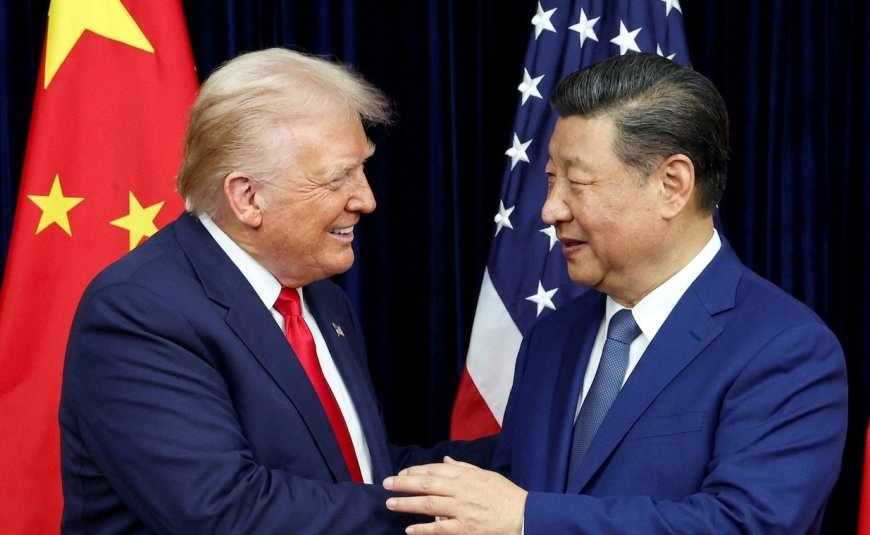
During his mid-May 2026 visit to Beijing, which took place against a backdrop of tense global issues like the conflict in Iran, shipping security in the Strait of Hormuz, and the future of Taiwan, Trump pointedly deflected the reporter's framing.
Responding aboard Air Force One, Trump stated: "I don't think about it. He's the ruler, he's the president of China... You have to deal with what you have. I respect him. He's very smart. He loves his country... whether he's a dictator, that's for you to figure out."
Trump’s refusal to endorse the reporter's label underscores a fundamental rule of international statecraft that the media often ignores: you must negotiate with the reality of power, not the morality of a label.
For an American president engaged in vital negotiations over global trade, avoiding conflict over Taiwan and preventing a nuclear Iran, engaging in public name-calling would be a diplomatic disaster.
A Critically Flawed Mirror: Looking Inward
The premise of the question is further hollowed out when contrasted with the internal contradictions of Western leadership.
Critics of the media’s framing point out that while journalists demand foreign leaders be condemned, American presidents themselves often preside over deeply controversial, heavy-handed domestic and foreign policies:
Domestic Overreach: From utilising agencies like the Immigration and Customs Enforcement (ICE) in ways that critics argue infringe upon civil liberties, to overseeing systemic socio-economic pain, domestic governance in the West is far from flawless.
Global Interventions: Western foreign policy has historically initiated or enabled devastating, senseless conflicts worldwide that have led to the deaths of innocent civilians and children, while destabilising entire regions.
For a Western reporter to adopt a posture of supreme moral authority while ignoring these severe domestic and foreign policy failures demonstrates a profound lack of self-awareness.
Conclusion: A Failed Frame
Ultimately, asking a sitting U.S. President if the leader of the world's second-largest economy is a "dictator" is an exercise in performative journalism.
It does nothing to unpack the nuances of U.S.-China relations, trade policies or security frameworks. Instead, it reduces global diplomacy to a schoolyard binary.
By dismissing the question and telling the press "that's for you to figure out," Trump highlighted the irrelevance of the media's obsession with labels when compared to the hard, pragmatic realities of global superpower diplomacy.
Asante Sana!!
What's Your Reaction?
 Like
0
Like
0
 Dislike
0
Dislike
0
 Love
0
Love
0
 Funny
0
Funny
0
 Angry
0
Angry
0
 Sad
0
Sad
0
 Wow
0
Wow
0