Chamisa, Chin’ono Clash Over CCC Leadership and Infiltration Claims
Former CCC leader Nelson Chamisa and journalist, Hopewell Chin’ono, have engaged in a public dispute over the collapse of Zimbabwe's main opposition movement, exchanging counter-arguments on political infiltration, leadership accountability and structural governance.
 Harry Taruva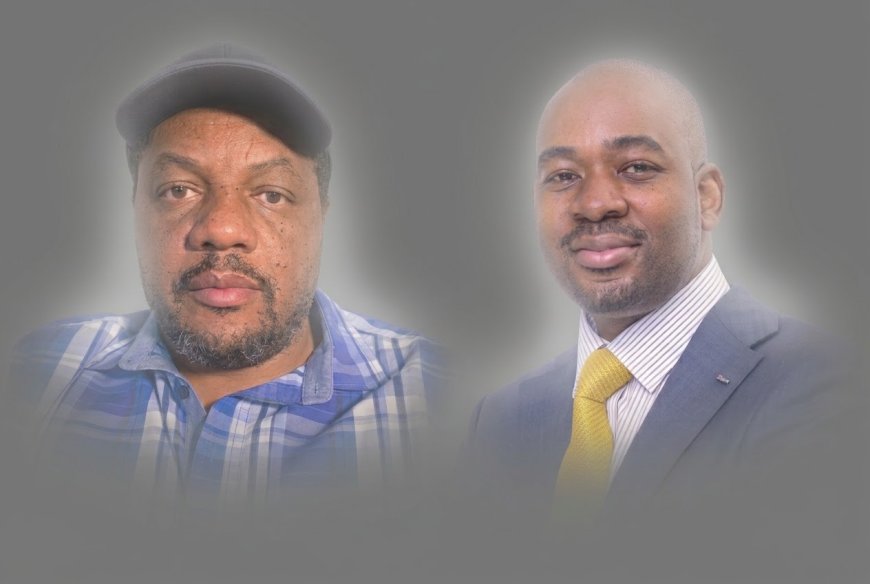
Harare — Former Citizens Coalition for Change (CCC) leader Nelson Chamisa and journalist Hopewell Chin’ono have clashed publicly over the collapse of the opposition movement, with the two exchanging sharply worded statements over allegations of infiltration, leadership accountability and the need for a political “fresh start”.
The dispute followed a statement by Chamisa in which he claimed that the events surrounding the CCC’s fragmentation and the recall of its legislators had exposed what he described as President Emmerson Mnangagwa’s strategy to manipulate the Constitution and extend his tenure in office.
Chamisa said his experience in the CCC had shown the extent to which political opponents could allegedly use money, infiltration and state power to weaken opposition movements.
“THE CAT NOW OUT OF THE BAG,” Chamisa said, adding that “When Tshabangu happened and when I left the CCC snake pit, many were simply too slow to see ED’s endgame: manipulating the Constitution and using every available means to illegally extend illegitimate term in office.”
Chamisa, who led the CCC after its formation in 2022, further alleged that the scale of political manipulation was unprecedented.
“The scale of bribery, infiltration and manipulation through money, trinkets, state capture and the abuse of power is staggering,” he said.
He added that the opposition struggle would continue despite the setbacks.
“But then fighting evil is never easy and will not stop. The struggle continues. Hope is not lost. Good will ultimately win and defeat all evil,” Chamisa said.
He said the experience had also exposed people he regarded as “pretenders and infiltrators”, creating an opportunity to rebuild the opposition movement.
“Now it’s easy to start afresh because pretenders and infiltrators are now fully known and more will come out. We’re starting all over again. A fresh start!” he said.
Chin’ono challenged Chamisa’s account, arguing that the CCC’s organisational weaknesses were rooted partly in the leadership model adopted by its founder.
He said Chamisa had founded the CCC and assumed its presidency but had not established a conventional party constitution, elected leadership or accountable structures.
According to Chin’ono, the publicly recognised national officials included then Spokesperson Fadzayi Mahere, National Organiser Amos Chibaya and Deputy Spokesperson Gift Ostallos Siziba, while major decisions remained concentrated around Chamisa.
“Everything else revolved around him,” Chin’ono said, arguing that Chamisa selected candidates, controlled decision-making and resisted calls to establish stronger institutional structures.
He questioned whether a movement without formal structures could later attribute its internal problems solely to infiltration.
“If CCC became a snake pit, who built the pit? If infiltrators occupied the movement, through whose leadership did they enter and rise?” Chin’ono asked.
Chin’ono argued that the absence of formal rules, transparent records, elected structures, collective decision-making and accountability mechanisms had left the movement vulnerable.
“Infiltration thrives where there are no rules, no transparent records, no elected structures, no collective decision-making and no mechanisms for accountability,” he said.
The institutional question was also raised by Chiredzi Central legislator, Blessing Ropafadzo Makumire, who said opposition parties should be structured to withstand attempts at infiltration and internal disruption.
“Infiltration of opposition parties by incumbents is inevitable,” Makumire said.
“The real question is whether the institution is strong enough to withstand it," he said.
Honourable Makumire said opposition movements needed structures capable of surviving pressure beyond individual political leaders.
“A serious opposition must be built to survive infiltration, intimidation, defections and internal sabotage,” Makumire said.
“Institutions must be strong enough to outlive those who seek to capture them," he said.
He said political organisations should respond to infiltration by strengthening their institutions rather than allowing it to undermine their operations.
“The answer to infiltration is not paranoia. It is institutional resilience,” Makumire said.
His comments come against the background of longstanding public debate over the organisational structure of the CCC.
In April 2022, constitutional law expert and academic, the late Dr. Alex Magaisa, urged the party to prioritise the establishment of a constitution, arguing that the party’s constitution should determine its organs, roles, functions and powers.
Controversy over CCC structures was also publicly documented at the time.
Chamisa defended the party’s approach, saying it was deliberately operating differently from established political parties and arguing that its strategy would prove itself in the 2023 elections.
Chin’ono said those warnings should now be considered in assessing what happened to the movement.
He argued that leadership required accepting responsibility for decisions that contributed to an organisation’s vulnerabilities, rather than attributing its collapse entirely to external actors.
“Leadership is not merely about claiming foresight after disaster,” Chin’ono said, “It is about accepting responsibility for the decisions that made the disaster possible.”
He further called on Chamisa to acknowledge the shortcomings of the previous political project before embarking on another one.
“Starting again without confronting the leadership failures that destroyed the previous movement is not renewal. It is simply repeating the same mistake under a new name,” he said.
Chin’ono, however, distinguished his criticism of Chamisa from the conduct he attributed to ZANU PF and the Government.
“ZANUPF’s infiltration and abuse of state power must be condemned, but that cannot become an excuse for failed leadership,” he said.
The disagreement subsequently turned personal, with Chamisa accusing Chin’ono of spreading misinformation.
“Dear Hopewell Chin’ono, a proper and balanced journalist is a truth-teller who reports facts, not fiction,” Chamisa said.
“Be a journalist, not a propagandist who peddles lies and misinformation to serve the interests of the oppressors.
"I have tolerated your tomfoolery for far too long. Enough is enough," he said.
Chin’ono responded by challenging Chamisa to identify the specific claims he considered false.
“Please identify the specific lies and misinformation you claim I have peddled. Point to the precise statement, explain what is false about it and provide the correct facts,” Chin’ono said.
He argued that political leaders should expect scrutiny from journalists and that criticism should not automatically be characterised as political propaganda.
“You are a political actor and Zimbabwe’s leading opposition politician,” Chin’ono said.
“You say that you are fighting for democracy, yet an essential part of democracy is the right of journalists to scrutinise, question and criticise political leaders, including opposition leaders," he said.
Chin’ono also objected to Chamisa’s use of the word “tolerated” in describing his relationship with the journalist.
“A politician does not tolerate a journalist. Journalists do not require permission from politicians to do their work,” he said.
He challenged Chamisa to provide evidence of any factual errors and said he would correct any demonstrable mistakes.
“If you demonstrate that I made a genuine factual error, I will correct it because that is what responsible journalists do,” Chin’ono said.
The exchange has brought renewed attention to the organisational questions that surrounded the CCC before its collapse.
The party's structure, or lack thereof, was a subject of public debate well before the 2023 general elections.
Magaisa's 2022 intervention specifically argued that a constitution was necessary to establish the party's organs and clarify their powers and functions.
The debate is now being revisited as Chamisa signals a new political beginning while critics, like Chin'ono, argue that any rebuilding exercise would need to address the institutional weaknesses that characterised the CCC.
Chamisa, however, maintains that the central issue remains what he describes as state interference and efforts to undermine Zimbabwe’s opposition.