
Youth Service and Police Recruitment: A Public Policy Test of Fairness, Merit and Trust
Zimbabwe’s Youth Service police recruitment policy faces scrutiny over transparency, merit, equal opportunity and the treatment of graduates.
 Dumisani Ndlovu
Harare — Zimbabwe's Youth Service policy is facing a critical public-policy test, with observers asking if government can promote Youth Service graduates for public-sector opportunities without undermining the principles of merit, equal opportunity, transparency and public confidence in state institutions.
The question has become increasingly important following the 2026 Zimbabwe Republic Police (ZRP) recruitment exercise and two internal memoranda from the Ministry of Youth Empowerment, Development and Vocational Training seeking information on the recruitment and absorption of Youth Service in Zimbabwe (YSZ) graduates.
The documents do not, by themselves, establish that the police recruitment process was unfair or politically manipulated.
They do, however, reveal that government was sufficiently concerned about the outcome of YSZ graduates' applications to seek provincial statistics on those who applied, those who succeeded and the reasons unsuccessful graduates were not enrolled.
That makes the issue more than a recruitment dispute but a question of public policy implementation and institutional credibility.
On April 8, 2025, Cabinet directed security-sector ministries, including the ZRP, to prioritise qualified Youth Service graduates during recruitment.
Qualified, suggests that Youth Service participation is intended to give eligible graduates preferential consideration, but does not necessarily eliminate the other requirements applicable to police recruitment.
This creates a delicate policy balance, government must honour its commitment to Youth Service graduates while ensuring that recruitment into a professional security institution remains transparent, competitive and based on clearly established standards.
If the policy is implemented inconsistently, graduates may feel that a government promise has been broken.
If the Youth Service certificate becomes an automatic gateway into the police service, however, the public could reasonably question whether professional recruitment standards are being weakened.
The credibility of the policy therefore depends not only on who is recruited, but also on whether government can explain why each category of applicant succeeds or fails.
The July memoranda exposes the accountability gap.
The Ministry's memorandum dated July 21, 2026, provides an important window into the problem.
Provincial structures were instructed to submit the number of YSZ graduates who applied for the 2026 ZRP recruitment, the number who were successful and the reasons given for unsuccessful applicants not being enrolled.
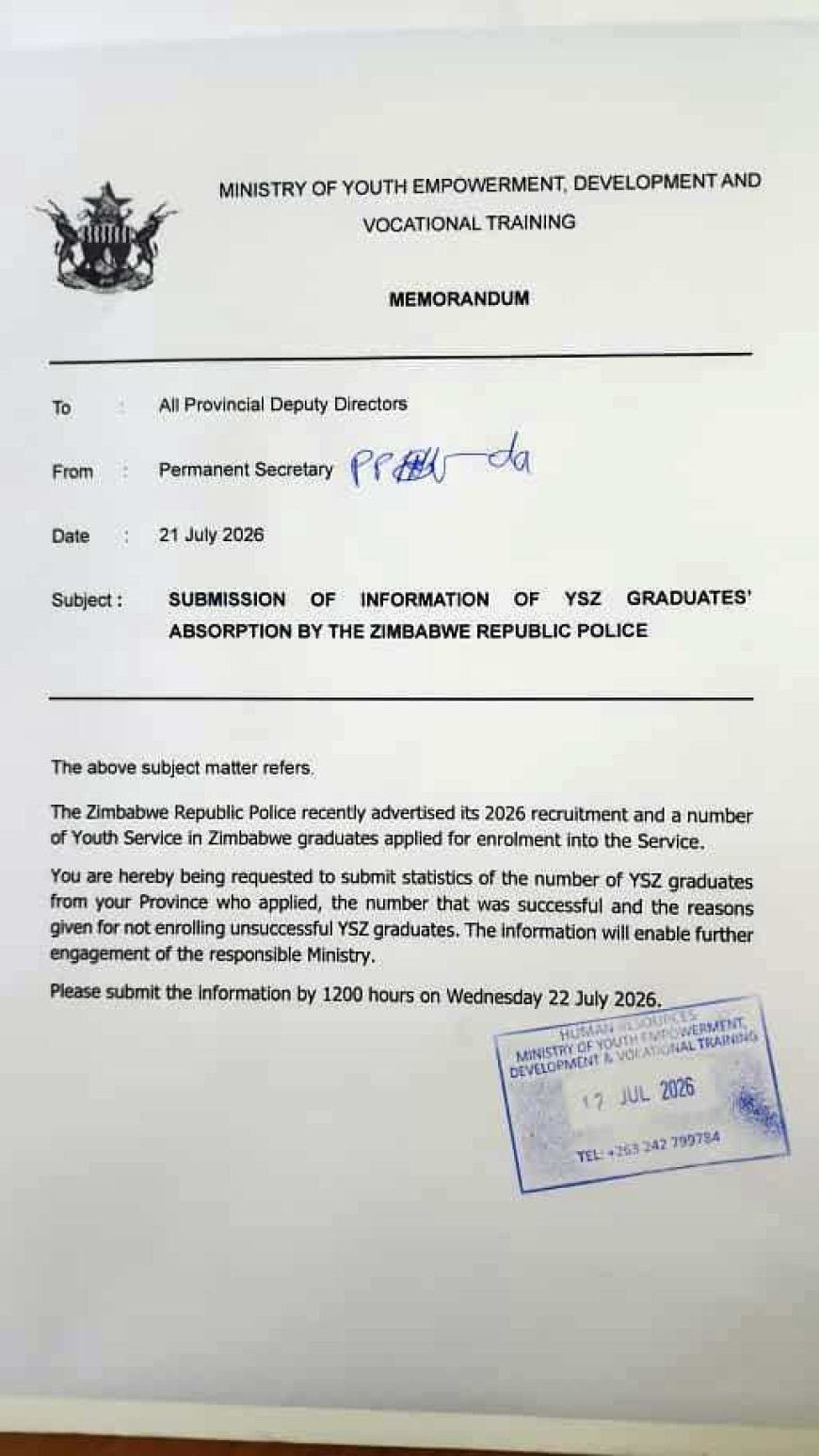
It effectively acknowledges that there is a need to establish what happened to Youth Service graduates after they entered the recruitment process.
The second memorandum, dated July 24, goes further by revealing that a significant number of YSZ graduates were not registered in the Public Service Commission recruitment database.
The Ministry warned that without registration, the Commission could not consider or refer those graduates for possible placement interviews.
From a public-policy perspective, this exposes a potential administrative weakness.
A government can create an employment-integration policy, but the policy cannot succeed if its intended beneficiaries are not properly captured in the systems through which public employment is administered.
The real issue is not Youth Service, it is fairness. The public debate should therefore move beyond the question of whether Youth Service is good or bad.
The more important question is, what safeguards exist to ensure that Youth Service integration is fair, transparent and consistent with professional recruitment standards?
There are legitimate policy arguments supporting Youth Service.
The programme is presented by government as a mechanism for promoting patriotism, discipline, vocational skills, civic responsibility and youth empowerment.
For a country struggling with youth unemployment, creating pathways from structured national service into employment can also be viewed as a legitimate public-policy intervention.
But employment policy carries a different obligation.
Public jobs are ultimately public resources.
Access to them must be governed by rules that citizens can understand and trust.
The danger of creating two classes of young people.
The controversy becomes particularly sensitive when Youth Service participation appears to determine employment prospects.
If a Youth Service certificate becomes effectively indispensable for accessing government employment, young Zimbabweans who did not participate in the programme could perceive themselves as being placed in a permanently disadvantaged category.
That could create a broader social-policy problem.
Government would effectively be creating two categories of young citizens:
those who possess the preferred certification and those who do not.
Such a system could undermine confidence in equal opportunity unless there are clear, lawful and publicly understood reasons for the distinction.
At the same time, dismissing the value of Youth Service participation would also be unfair to graduates who invested time and effort in the programme on the understanding that government would recognise their training.
The solution is therefore not necessarily to abandon preferential consideration.
It is to make the rules transparent.
Police recruitment requires an even higher standard. The issue becomes more serious when the employment pathway leads into the police service.
The police are entrusted with extraordinary powers, including arrest, investigation, maintenance of public order and enforcement of the law.
Consequently, public confidence in police recruitment is not merely an administrative matter.
It is part of national security and institutional legitimacy.
The public must be confident that recruits are selected because they meet established professional standards and are suitable to exercise those powers.
Youth Service training may be an additional qualification or advantage.
It should not, however, create uncertainty about the integrity of the selection process.
The principle should be straightforward:
Youth Service can strengthen a candidate's profile, but transparent recruitment standards must remain visible and enforceable.
Midlands becomes an important test case
Reports from Midlands Province that some YSZ graduates with good academic results were not accommodated in the 2026 police recruitment exercise have intensified the debate.
Those reports should not automatically be interpreted as evidence of discrimination or political bias.
But they deserve investigation. The Ministry's July 21 memorandum provides an obvious mechanism for that investigation: establish how many YSZ graduates applied, how many were successful and why the unsuccessful applicants were rejected.
The public interest would be served by making aggregated results available.
Such transparency would answer several questions.
Were unsuccessful graduates rejected because they failed academic requirements?
Did they fail physical assessments?
Were there medical or other suitability requirements?
Were applications incomplete?
Were there more qualified candidates than available places?
Or was the Youth Service preferential-treatment policy applied differently across recruitment centres?
Without this information, speculation will inevitably fill the information gap.
From preferential treatment to transparent treatment, the government's policy challenge is therefore not simply whether YSZ graduates should receive preference.
It is how that preference is administered.
A transparent framework could, for example, clearly distinguish between:
minimum eligibility requirements;
professional and physical suitability requirements; the role of Youth Service certification; the meaning of "preferential consideration"; the ranking of candidates;
the reasons for rejection; and
mechanisms for applicants to challenge or clarify recruitment decisions.
It would protect Youth Service graduates from being overlooked despite a government policy intended to benefit them.
It would also protect the ZRP from allegations that recruitment is based on political loyalty rather than professional suitability.
Government now has an opportunity. The two July memoranda present government with an opportunity to turn a growing controversy into a policy-strengthening exercise.
Publishing clear statistics on YSZ graduates who applied and were recruited would be an important first step.
Explaining the reasons for unsuccessful applications would be even more valuable.
Most importantly, government should clarify to young Zimbabweans exactly what Youth Service certification means in relation to public employment.
A policy that promises preferential consideration must be sufficiently clear for citizens to understand what they are entitled to expect.
And a recruitment system that rejects an applicant must be sufficiently transparent for that applicant to understand why.
The bigger public-policy question
Ultimately, this debate is about more than the Youth Service or the 2026 police recruitment exercise.
It is about the relationship between government promises and citizens' expectations.
When the state creates a programme and tells young people that participation will improve their employment prospects, it creates a legitimate expectation that the policy will be implemented consistently.
When the same state recruits into a professional security institution, it also has a responsibility to preserve merit, competence, impartiality and public trust.
These principles should not be enemies.
They can coexist. The challenge is to design a recruitment framework in which Youth Service graduates receive the preferential consideration government has promised without making the Youth Service certificate a substitute for competence, suitability and transparent selection.
The July memoranda have opened the door to that conversation.
The public now needs the numbers, the criteria and the explanations.
Because in public-sector recruitment, fairness is not only about getting the right people into the system, it is also about ensuring that those who are left outside can understand why.