China’s US$120bn Global Minerals Investment Threatens Australia’s Export Dominance
A report by Climate Energy Finance warns that China is aggressively diversifying its critical mineral and iron ore supply chains away from Australia through a US$120 billion global investment blitz, leaving Australia’s "dig-and-ship" economy exposed to long-term risk.
 Harry Taruva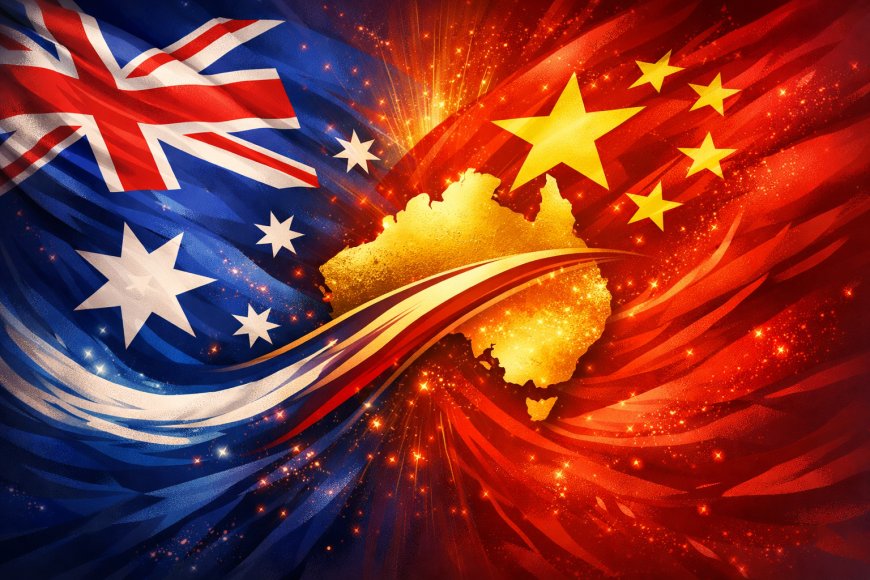
Sydney - Australia’s long-standing dominance in the global resources sector faces an existential threat as China executes a strategic US$120 billion investment blitz into rival mining jurisdictions, according to a major report released on Wednesday by independent think tank, Climate Energy Finance (CEF).
The report, titled "Raw Power: China locks-in global dominance of critical minerals and metals with $120bn outbound investment surge," warns that Beijing is systematically reducing its reliance on Australian exports by building integrated supply chains across Africa, South America and South-east Asia.
CEF data reveals that China has directed more than US$120 billion into global mining and upstream processing since 2023.
The diversification is visible in the iron ore sector where the China-backed Simandou project in Guinea delivered its first shipment in January.
Experts predict that by 2029, Guinea will become the world’s third-largest iron ore exporter, directly challenging Australia's market share with high-grade ore suited for green steel production.
Tim Buckley, CEF Director and former Managing Director of Citigroup, said the data reveals a closing window for Australia to evolve beyond a "dig-and-ship" model.
"Australia is sitting on some of the world's most strategically valuable resources at precisely the moment the global economy is reorganising itself around them. But sitting on them is all we are doing," Buckley said.
"The money shows a clear pattern, and it is imperative that we act now to shift these dynamics in Australia's favour to become a renewables powered mining and value-adding superpower or risk remaining on the sidelines as the world’s quarry," he said.
The report highlights a contrast in investment trends whereby, while two-way trade between Australia and China hit a record A$300 billion in 2025, Chinese outbound foreign direct investment (OFDI) into Australia has collapsed by 85 percent since 2018.
In 2024, Chinese investment accounted for just 1.5 percent of Australia’s total inbound OFDI.
The shift has already resulted in industrial casualties. Analysts pointed to the February 2026 closure of Albemarle’s lithium hydroxide plant in Western Australia as a consequence of China’s rapid capacity expansion elsewhere, which has suppressed prices and sidelined Australian processing efforts.
Matt Pollard, CEF Net Zero Transformation Analyst, said Australia must move to integrate Chinese technical expertise and capital into domestic projects if it hopes to remain competitive.
"The same model China has used to build green industrial capacity across the Global South is available to Australia, but a significant strategic shift of how Australia views its national interest and economic security must occur," Pollard said.
"For Australia to maximise its opportunity, we must leverage Chinese capital, technical expertise and integrate their supply chains into our renewable energy pipeline," he added.
The report also examines the geopolitical dimensions of the energy transition.
Associate Professor Marina Yue Zhang of the Australia–China Relations Institute at the University of Technology Sydney noted that the competition for net zero is now about control, not just technology.
"The challenge is not blanket exclusion, but the development of clearer policy settings and national objectives so that foreign investment, including from China, can be assessed according to whether it supports domestic value-adding," Professor Zhang said.
To counter these risks, CEF recommends that the Australian government accelerate its "Future Made in Australia" initiative, implement local content mandates, and reform the foreign investment review regime to create fast-track pathways for green industrial projects.
The think tank also urged the development of an "Australia-China Green Transition Cooperation Framework" to manage the bilateral trade relationship as China continues to seek alternative suppliers in Africa and South America.