ZRP Midlands Introduces Body Cameras, Relaunches Client Service Charter
Commissioner Patson Nyabadza spearheaded the 2026 reinvigoration of the Zimbabwe Republic Police Client Service Charter in Midlands Province, introducing body-worn cameras and strict professionalism standards to rebuild public trust and enhance community safety.
 Delicious Mathuthu
Gokwe Centre - The Zimbabwe Republic Police (ZRP) has introduced the use of body cameras for officers as part of a move to repair fractured public trust and modernize its operations in the Midlands Province, with leadership pledging a decisive turn in law enforcement standards.
This was revealed during the formal relaunch of the Client Service Charter on Wednesday, February 3, in Gokwe.
Commissioner Patson Nyabadza, the Officer Commanding Police for Midlands Province, addressing a gathering of stakeholders at Gokwe Centre, said police are reinvigorating the province’s commitment to a national mandate first established in Harare earlier this year.
The Commissioner characterized the updated charter not merely as a bureaucratic document, but as a solemn pledge and handshake extended to every resident, visitor and citizen within the province.
The relaunch comes at a critical juncture for the ZRP with Commissioner Nyabadza candidly acknowledging that the relationship between the police and the public has suffered in recent years.
He noted that the command is not blind to murmurs of discontent circulating in marketplaces and local media.
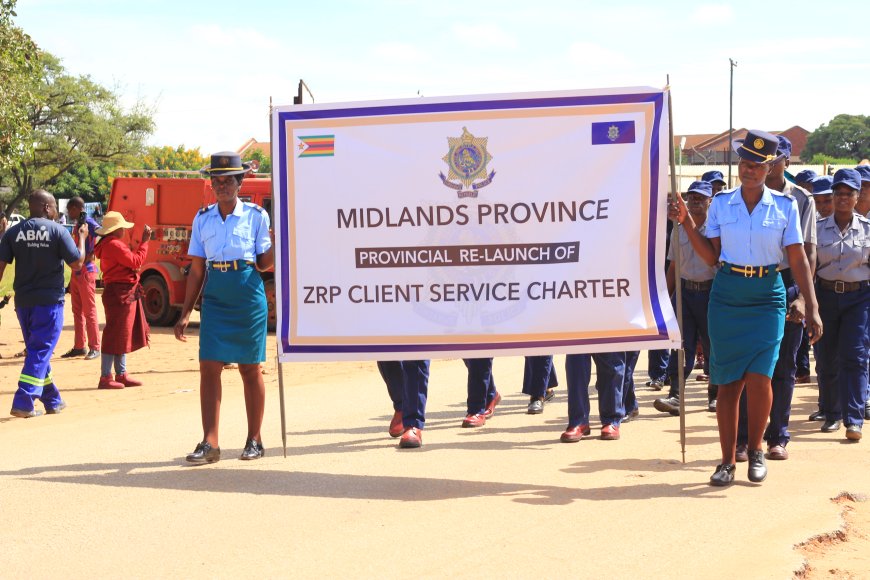 Police procession during the Midlands ZRP Client Service Charter relaunch at Gokwe Centre
He admitted that trust has deteriorated in certain instances, framing the new charter as the primary vehicle for rebuilding that lost confidence.
"The Charter we are reproclaiming today marks a decisive turn," Commissioner Nyabadza stated, adding that "it is a call to unity, to move beyond our gates and join a collective front against crime."
Central to the reinvigorated policing impetus is the introduction of new accountability measures designed to bring integrity "out of the shadows".
The Commissioner announced that police officers have begun using body-worn cameras, a technological shift intended to serve as both a deterrent against misconduct and a protective shield for honest members of the force.
The command has also mandated that no officer may be deployed in uniform without a visible name tag, ensuring that every interaction remains personal and traceable.
The Commissioner detailed specific service standards that citizens should now view as a right, including the provision of reference numbers for all reports and the right to follow-up feedback.
Commissioner Nyabadza said the force must be defined by integrity and a commitment to justice rather than just the uniform.
"We promise you swiftness," Nyabadza said, "where prompt and reliable responses with clear timelines will be our guiding principle," he added.
However, the Commissioner was clear that the success of the charter remains a two-way engagement.
He urged the public to actively participate in community safety by joining neighborhood watch schemes and reporting all suspicious activity, regardless of how minor it may seem.
 Some members of the public gathered to witness the ZRP Client Service Charter relaunch, Gokwe Centre
Using a pastoral metaphor, he compared the police to shepherds and the community to a flock, asserting that while shepherds protect the flock, they rely on the sheep to raise the alarm when a predator is near.
Commissioner Nyabadza also highlighted the police’s role in Zimbabwe’s broader economic goals.
As the country moves toward "Vision 2030," the Commissioner noted, an empowered upper-middle-income economy requires a foundation of safety and security.
He challenged his subordinates to embody the values of impartiality and respect, reminding them that they are the most visible arm of the government.
"Let us be the face of hope, not of fear," Commissioner Nyabadza told the assembled rank and file, "be the face of justice, not of judgment. Be the solution, not an obstacle".
The Commissioner concluded by inviting the public to hold the service accountable through the contact details provided in the charter, noting that even critical feedback serves to strengthen the organization.
He maintained that the ZRP is prepared to be judged by the results it delivers rather than the "elegance of its words".