Thousands of 'Hidden' Coral Reefs Mapped in Northern Australia
Researchers from the Australian Institute of Marine Science have used satellite imagery to identify and map over 1000 previously uncharted coral reefs across northern Australia.
 Harry Taruva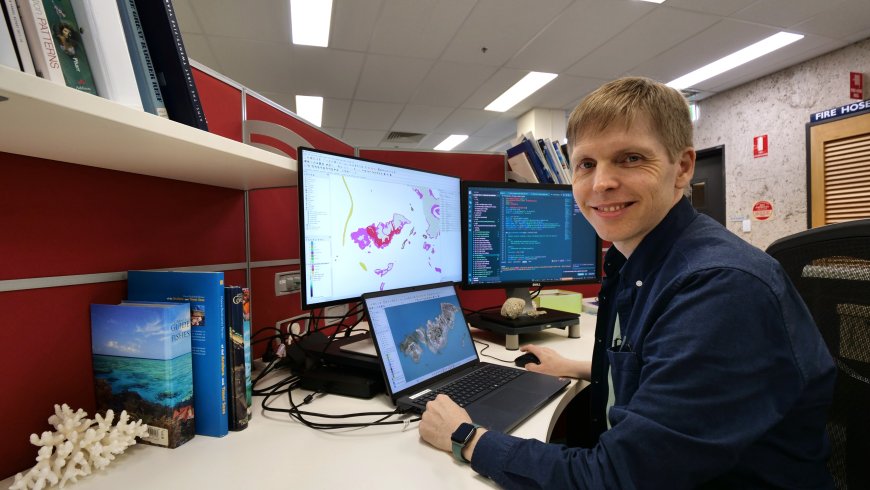
Townsville, Queensland - Scientists have discovered and mapped more than 1,000 previously uncharted coral reefs across northern Australia using a pioneering method that requires no physical sea expeditions.
The breakthrough, led by the Australian Institute of Marine Science (AIMS), has revealed a vast underwater network stretching from the Houtman Abrolhos in Western Australia to the western edge of Cape York in Queensland.
For decades, these ecosystems remained "invisible" to formal conservation efforts and development planning, often obscured by the sediment-rich, murky waters characteristic of the northern coastline.
The project relied on the synthesis of satellite data, allowing researchers to peer through turbid waters that usually appear as opaque turquoise in single images.
By layering hundreds of images taken at different times, constant features such as the reefs became visible while the shifting patterns of moving water were filtered out.
Dr Eric Lawrey, the AIMS e-Atlas Project Manager who spearheaded the initiative, noted that while local communities may have been aware of specific sites, the formal mapping of the region remained remarkably sparse until now.
"If you look at any one satellite image, the water just looks like turquoise paint and you can’t really see reefs," Dr Lawrey said.
"But if we overlay 200 images of the area, taken at different times, to create a composite image, all the swirly patterns of the moving water move around and average out while the reefs are constant."
While the Great Barrier Reef has long been the primary focus of Australian marine research, the northern coastline has historically been under-surveyed.
The institution says most existing maritime charts for the region were designed for navigational safety rather than biological study, often failing to distinguish between coral structures and rocky outcrops.
The new data suggests that northern Australia possesses a quantity of reefs comparable to the Great Barrier Reef, though many in the north are significantly smaller in scale.
The digitisation process alone required 700 hours of work to accurately classify 3,600 coral reefs and 2,900 rocky reefs.
"The number of reefs we found inshore was a surprise," Dr Lawrey said, adding that "It became a bit of a problem for our project because we had to map so many of them."
Coral reef mapping traditionally relies on clear, shallow water where light penetration allows for easy aerial or satellite detection.
However, the waters of northern Australia are often macrotidal and heavy with sediment, creating a natural veil over the seabed.
The lack of visibility has led to a significant data gap in Australian marine management.
Without precise maps, AIMS said, these reefs were frequently excluded from environmental impact assessments and regional conservation strategies.
The emergence of high-frequency satellite imagery, such as that used in Google Earth, provided the initial spark for this project over a decade ago.
By treating the ocean's surface as a variable and the seabed as a constant, researchers have effectively created a clear window into a previously hidden world.
"It’s a vast set of reefs that’s been largely unknown about," Dr Lawrey said.
"Well, maybe I should say unmapped, because I'm sure people that are there, or locals, know about all these places," he said.
The project, funded under the National Environmental Science Program, has now made its datasets available to the public.
Experts believe this comprehensive view will be vital for the future protection of northern marine ecosystems as they face increasing pressures from industrial development and climate change.