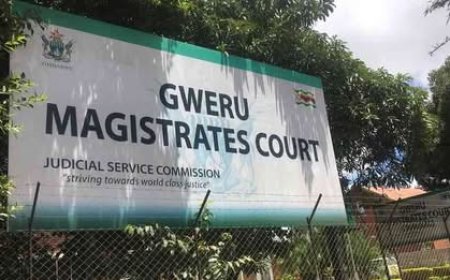
High Court Overturns ZANU PF Activists Conviction in CID Detective Torture Case
By Dumisani Ndlovu — The Bulawayo High Court has acquited Isheanesu Benjamin Marima and three co-accused of kidnapping a CID Detective during CAB3 hearings in Gokwe, overturning seven-year sentences with assault convictions and fines.
 Dumisani Ndlovu
Bulawayo – The Bulawayo High Court has acquitted ZANU-PF youth activist and Zimbabwe Prisons and Correctional Services (ZPCS) Officer Isheanesu Benjamin Marima and his three co-accused in the case of kidnapping a Criminal Investigations Department (CID) Detective during Constitutional Amendment Bill No. 3 (CAB3) public hearings in Nembudziya, Gokwe.
Marima, Wonder Gomba, Collen Masawi, and Edwin Chinongwa were, however, convicted on two counts of assault and fined US$200 on each count, resulting in a total fine of US$400 per offender.
The High Court, sitting with Justices Munamato Mutevedzi and Bongani Ndlovu, set aside the kidnapping convictions and the seven-year prison terms previously imposed by Gokwe Regional Magistrate, Stanford Mambanje.
The court further suspended the custodial sentence on condition that the four offenders pay their fines by October 28, 2026.
Failure to pay the fines will result in each offender serving eight months' imprisonment, the High Court said.
Each was also sentenced to a further four months' imprisonment, wholly suspended for five years on condition that they do not commit any offence involving violence for which, upon conviction, they are sentenced to imprisonment without the option of a fine.
The ruling followed an appeal in which defence lawyers, Ernest Muzembe and Whatmore Gandi, challenged the lower court's handling of the kidnapping charge.
In a major, intense legal battle, the defence mounted a challenge to the trial court's findings, focusing on the critical legal distinction between assault and kidnapping, particularly the element of intention.
Muzembe argued that the magistrate had failed to distinguish between the two offences, especially regarding the accused persons' intent.
He submitted that physical restraint may occur during the commission of an assault, but that fact alone does not establish the specific intention necessary to sustain a kidnapping conviction.
"You realise that for kidnapping, the intention in some instances was probably the assault, for example if the accused are demanding money.
"But when someone is taken, beaten up, and retained, the intention is to assault," Muzembe submitted.
"Where is the kidnapping then? There is no other evidence surrounding the kidnapping of the accused person. The evidence points to a mere assault."
Gandi similarly argued that the trial court had failed to properly assess the essential element of intention when convicting the four accused of kidnapping.
"The court fell into error in failing to appreciate an essential element of the charge, which is intention," he submitted.
He argued that the evidence before the court demonstrated an intention to assault rather than an intention to kidnap the complainant.
The defence also raised the personal circumstances of the accused in mitigation, noting that they were first offenders, had spent time in custody and had consistently attended court proceedings.
Gandi further submitted that Marima, as a prison officer, could face disciplinary action or even lose his employment as a consequence of the conviction.
Before the appeal was heard, the four had been granted bail pending appeal, with each ordered to deposit US$50 with the Registrar of the High Court.
The appeal arose from convictions handed down by Magistrate Mambanje following a fully contested trial in which all four accused denied the allegations.
The State had alleged that CID Law and Order Detective Constable Bester Tati was lured away from a CAB3 public hearing venue in Nembudziya under the pretext of discussing security matters.
According to the State's case, Constable Detective Tati was then forced into a waiting vehicle and driven to a secluded area in Maselukwe, where he was assaulted and subjected to falaka, a form of torture involving repeated strikes to the soles of the feet.
He was later dumped at Mutora Business Centre.
Following the trial, Mambanje convicted the four of kidnapping and assault and sentenced them to seven years' imprisonment.
The quartet also faced a separate case arising from the alleged kidnapping and assault of a kombi driver at Gokwe Centre, for which they were sentenced to four years' imprisonment.
They subsequently challenged both their convictions and sentences before the High Court.
Then, the State was represented during the trial by prosecutor Malvern Nzombe, while the accused were represented by lawyers Thomas Militao and Whatmore Gandi.
The High Court appeal has now resulted in the kidnapping convictions being set aside, with the four acquitted of that charge and instead convicted of the lesser offence of assault.
This outcome effectively overturns the most serious component of the original judgment, leaving only the assault convictions and the associated fines in place.