Hailstorms Moving Toward Poles, Threatening Winter Crops
A new study by the University of New South Wales, Sydney, reveals that global warming is shifting destructive hail-prone weather systems toward cooler regions, putting vulnerable winter wheat crops at risk.
 Harry Taruva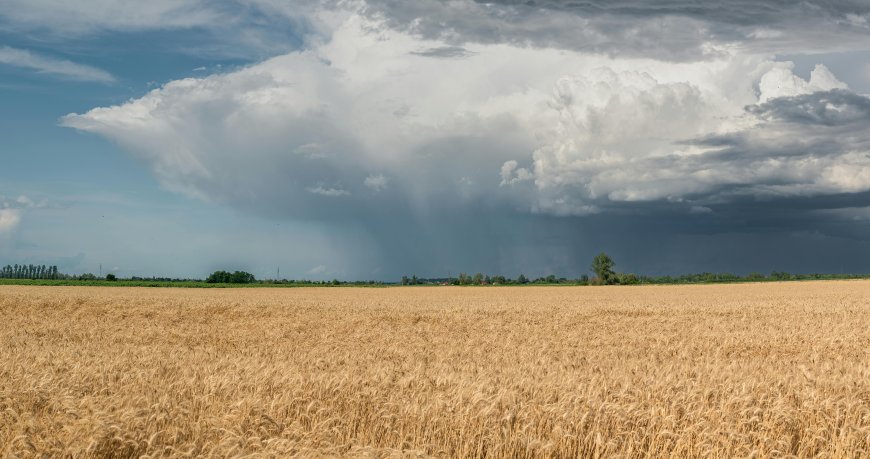
Sydney - Destructive hailstorms are shifting away from the subtropics and moving directly toward the Earth's poles as global temperatures rise, leaving vital winter crops exposed to severe weather patterns.
A new study published in Nature Climate Change by researchers at the University of New South Wales (UNSW) Sydney warns that under models predicting a 2 degrees celsius (°C) to 3°C rise in global temperatures, the geographic and seasonal timing of hail risk will transform entirely, catching agricultural sectors off guard.
The data indicates that while subtropical zones may see a decrease in hail activity, cooler regions, including south-eastern Australia, New Zealand, northern parts of North America and northern Europe, will experience a sharp increase in hail-prone conditions during their traditional winter growing seasons.
"Under modelling scenarios of 2°C and 3°C of global warming, we see this overall shift towards more risk in cooler places and cooler times of the year," said lead author, Dr. Tim Raupach from the UNSW Institute of Climate Risk and Response.
"So increasing risk in winter and often decreasing risk in summer, a shift from warmer to cooler regions and seasons," he said.
Predicting hail trends has historically proven difficult due to the brief, highly localised nature of storms.
Rather than modeling individual hailstones, the UNSW team mapped three distinct atmospheric variables that trigger major storms, revealing an atmospheric "tug of war."
While warmer air provides more thermodynamic energy to fuel strong storm updrafts, which can grow larger hailstones, it also raises the freezing altitude, meaning smaller hailstones are more likely to melt into rain before hitting the ground.
"The atmosphere might be more prone to create storms, but the storms that are created might be less likely to have hail reach the ground," Dr. Raupach explained.
He however warned that the storms that do break through are likely to feature larger, far more destructive hailstones.
"That still has important implications for agriculture," he said.
The study analysed 26 major crop variants globally, highlighting a clear threat to south-eastern Australia's vast winter wheat belt, which stretches from Tasmania up through Victoria and New South Wales.
The shifting weather patterns present a major challenge to insurers, farmers and long-term climate adaptation strategies.
With agricultural operations naturally migrating poleward to escape rising equatorial heat, they are inadvertently moving directly into the path of expanding hail zones, potentially erasing any projected gains from longer growing seasons.