BRICS Pushes Local-Currency Trade, Cheaper Cross-Border Payments
By Delicious Mathuthu — BRICS leaders have backed practical cross-border payment solutions and greater use of local currencies in trade and investment as the bloc moves to deepen economic cooperation among member states.
 Delicious Mathuthu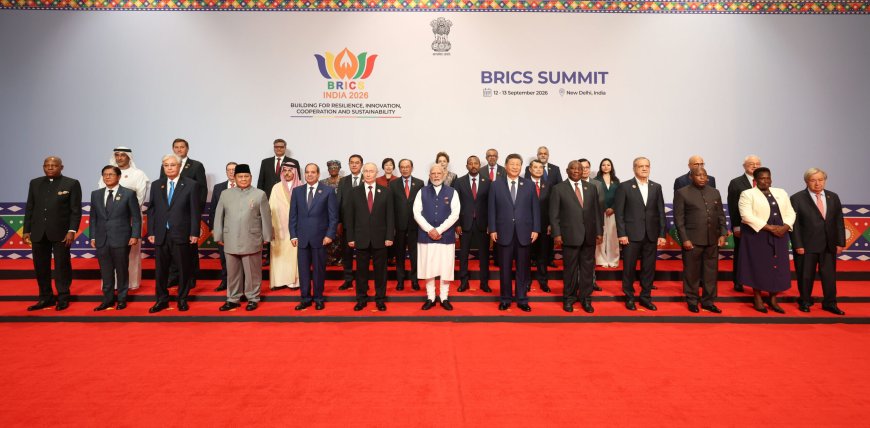
New Delhi — BRICS leaders have stepped up efforts to deepen economic cooperation among member states, backing practical solutions for cross-border payments and greater use of local currencies in trade and investment.
The decision was made at the 18th BRICS Summit in India, News Delhi, setting out further measures aimed at strengthening economic links among member states while reducing barriers to trade and investment.
The leaders said the BRICS Payment Task Force was examining practical ways of improving cross-border transactions, including the interconnection of payment and messaging channels.
“We acknowledge the work done to study the cross-border interoperability of payment and messaging channels, and the discussions on promoting trade settlements and investments using BRICS local currencies,” the summit declaration said.
The bloc however stressed that individual countries should retain control over their own priorities and approaches.
The leaders acknowledged that there is no one-size-fits-all approach to the development of cross-border payment arrangements.
They urged the Payment Task Force to continue working towards systems that make transactions “fast, low-cost, more accessible, efficient, transparent, and safe”.
The initiative forms part of a broader push to strengthen economic cooperation among BRICS members.
“We reaffirm our commitment to deepening pragmatic economic cooperation and advancing a closer economic partnership among BRICS members,” the leaders said.
They also endorsed further work under the Strategy for BRICS Economic Partnership 2030, which they described as the overarching framework for developing sectoral strategies, programmes and roadmaps.
Trade facilitation was another major element of the declaration, with BRICS leaders backing measures to improve the movement of goods and reduce administrative barriers.
They reaffirmed support for World Trade Organisation (WTO) reform and called for a non-discriminatory, open, equitable, transparent, fair, inclusive, predictable and rules-based multilateral trading system.
The declaration also called for the immediate restoration of an effective two-tier binding WTO dispute settlement system.
BRICS leaders welcomed China’s expansion of zero-tariff treatment to cover 53 African countries with which it has diplomatic ties, while supporting Ethiopia and Iran's bids to join the WTO.
The bloc also warned that rising tariffs, non-tariff barriers and protectionist measures were threatening international trade and disrupting global supply chains.
BRICS said it would work to make the WTO more responsive to the needs and priorities of emerging markets and developing economies.
The declaration further placed emphasis on helping developing countries move into higher-value areas of production rather than remaining concentrated in lower-value segments of global trade.
The leaders said they wanted to promote broader and more equitable participation of developing countries and emerging markets in higher-value added segments of global manufacturing and production."
They linked thie objective to trade and investment, technical cooperation, productive capacity and technology transfer.
Small and medium-sized businesses were also identified as a key area for cooperation, with BRICS acknowledging that access to finance remained a major obstacle.
“Access to affordable finance remains a primary bottleneck and structural constraint,” the summit declaration said.
The bloc said it would pursue measures including export-oriented credit assessment, digital and platform-based financing and invoice discounting to improve access to finance for smaller businesses.
BRICS leaders also backed greater cooperation on global value chains, Special Economic Zones and digital trade documentation.
They said Special Economic Zones could help promote trade, investment, industrial cooperation, innovation and integration into resilient and sustainable GVCs.
The declaration also addressed critical minerals, an increasingly important area of global trade and industrial development.
BRICS called for “reliable, responsible, diversified, resilient, fair, sustainable, and just supply chains of critical minerals”, while stressing the importance of value addition and economic diversification in resource-rich countries.
The leaders said cooperation in this area should preserve the sovereign rights of mineral-producing countries and ensure that they benefit from their natural resources.
Together, the measures form part of the bloc's stated effort to deepen economic integration while giving developing economies a greater role in global trade, production and investment.