U.S. Cuts Health Funding to Zimbabwe After America First 'Aid for Minerals' Fallout
The United States has initiated a withdrawal of health assistance from Zimbabwe following the collapse of a $367 million "America First" funding framework due to irreconcilable demands regarding strategic mineral access and health data sovereignty. Government spokesperson Nick Mangwana defended the termination as a necessary move to protect national resources and biological data from an asymmetrical, extractive diplomatic arrangement. This shift marks a definitive stand for resource nationalism, leaving a significant funding gap for 1.2 million citizens currently receiving HIV treatment.
 Delicious Mathuthu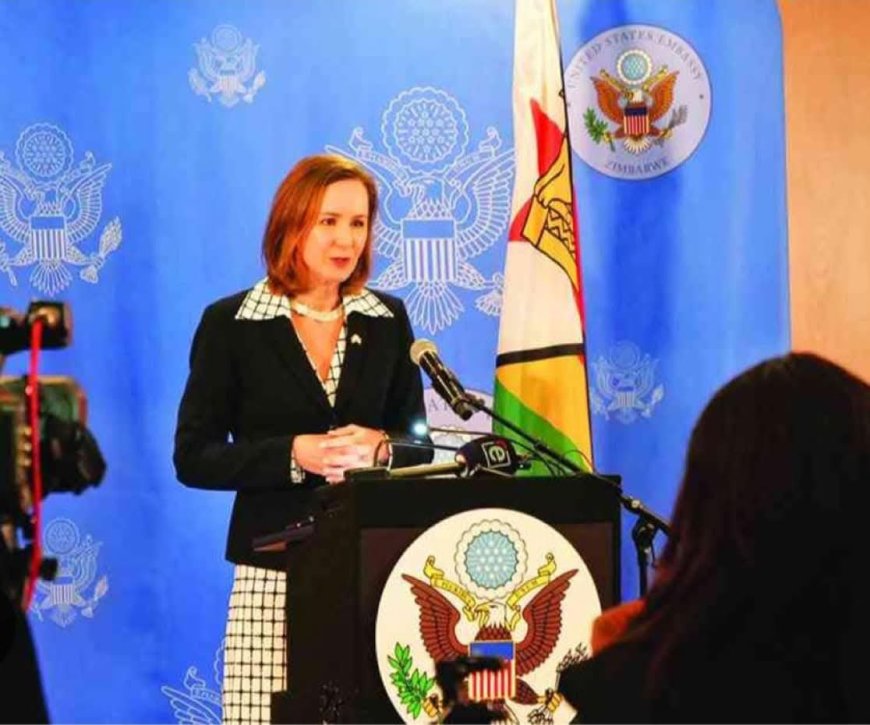
Harare - The United States Embassy in Harare has confirmed it will begin a "difficult and regrettable" withdrawal of health assistance in Zimbabwe, after President Emmerson Mnangagwa formally terminated negotiations on a US$367 million funding framework, Kwedu News has learnt.
In a statement released February 24, 2026, U.S. Ambassador to Zimbabwe, Pamela Tremont, framed the collapse of the Memorandum of Understanding (MoU) as a loss for sustainability and mutual accountability.
Her statement, however, notably omitted the contentious transactional demands that triggered the impasse, specifically Washington’s pivot toward linking humanitarian aid to strategic mineral access and health data extraction.
Analysts say the breakdown reflects a fundamental clash between the Trump administration’s "America First" diplomatic shift and Harare’s insistence on resource sovereignty.
Zimbabwe internal government directives, as reported by ZimLive online, say U.S. negotiators sought to fold Zimbabwe’s critical mineral ecosystem into the health arrangement, pushing for preferential access to lithium and platinum reserves essential for the global energy transition.
"The United States has a responsibility to American taxpayers to invest their resources where mutual accountability, transparency, and shared commitment are assured," Ambassador Tremont said in a statement.
From the perspective of the Zimbabwean executive, however, the shared commitment translated into a lopsided arrangement where medical assistance served as a tool for extractive diplomacy.
In a detailed response published in The Herald online, Government spokesperson Nick Mangwana clarified President Emmerson Mnangagwa administration's position, characterizing the decision as necessary, principled and entirely consistent with the country's sovereign rights.
While recognizing the historical contributions of U.S. health assistance through programs like PEPFAR, Mangwana emphasized that a partnership must be built on mutual respect and reciprocal benefit.
"The proposed agreement offered substantial health funding, reported to be in the region of US$328 million, in exchange for comprehensive access to Zimbabwe’s sensitive health data, including pathogen samples and epidemiological information," Mangwana revealed.
He said the arrangement was fundamentally asymmetrical:
"Zimbabwe was being asked to share its biological resources and data over an extended period, with no corresponding guarantee of access to any medical innovations, such as vaccines, diagnostics, or treatments, that might result from that shared data. In essence, our nation would provide the raw materials for scientific discovery without any assurance that the end products would be accessible to our people," Mangwana said.
The co-investment model mentioned by the U.S. Embassy under the America First Global Health Strategy (AFGHS) has already been applied across 18 other African nations, totaling about US$18.3 billion in signed agreements.
While Washington highlights the volume of this funding, the narrative often glosses over the extreme fiscal burden placed on host nations.
In Cameroon, the country is sexpexted to fund over 53% of the US$850 million agreed AFGHS agreements and Nigeria 59% of the agreed US$5.1 billion agreed under the program.
In neighboring Botswana, the government was forced to accept a deal where they must cover 78% of the total program costs ($381 million) just to unlock $106 million in U.S. support.
Mangwana further noted that Zimbabwe remains a firm believer in multilateralism, viewing the U.S. withdrawal from the World Health Organization (WHO) and its pursuit of bilateral agreements as a departure from established frameworks.
He highlighted that Zimbabwe, speaking on behalf of 50 African member states, insists that pathogen data be shared exclusively through the WHO’s Pathogen Access and Benefit-Sharing (PABS) framework to ensure equitable pandemic response.
The Zimbabwean Ministry of Mines reportedly viewed U.S. mineral-linked demands as a direct threat to existing long-term contracts, particularly those with Chinese state-owned enterprises that have already secured significant stakes in the country's lithium sector.
Officials argue that granting the U.S. a strategic vantage point through a health pact would violate prior commitments and compromise national security.
The sentiment was echoed by Mangwana, who stated that such an approach based on inequalities is not welcome.
"When financial assistance is contingent upon concessions that touch upon national security, data sovereignty, or access to strategic resources, it fundamentally alters the nature of the relationship from one of partnership to one of unequal exchange," Mangwana said.
Harare’s rejection was also partly fueled by demands for direct, real-time access to national health data, which security advisors classified as an intelligence overreach.
"The President has directed that Zimbabwe must discontinue any negotiation with the USA on the clearly lopsided MoU that blatantly compromises and undermines the sovereignty and independence of Zimbabwe," stated Ambassador Albert Chimbindi, Secretary for Foreign Affairs, in the original leaked government communication documents.
The U.S. Embassy said it currently has programs that are sustaining 1.2 million Zimbabweans on HIV treatment, said the Government of Zimbabwe said it is "prepared to sustain the fight" independently.
Mangwana maintained that the decision followed a thorough inter-ministerial review guided by foresight.
"True friendship between nations... is not measured by what one can extract from the other, but by the mutual respect with which they treat one another," Mangwana said, extending a hand for future cooperation based on dignity and equality.