High-Stakes Legal Drama Over President Mnangagwa’s Term as Advocate Withdraws
 Dumisani Ndlovu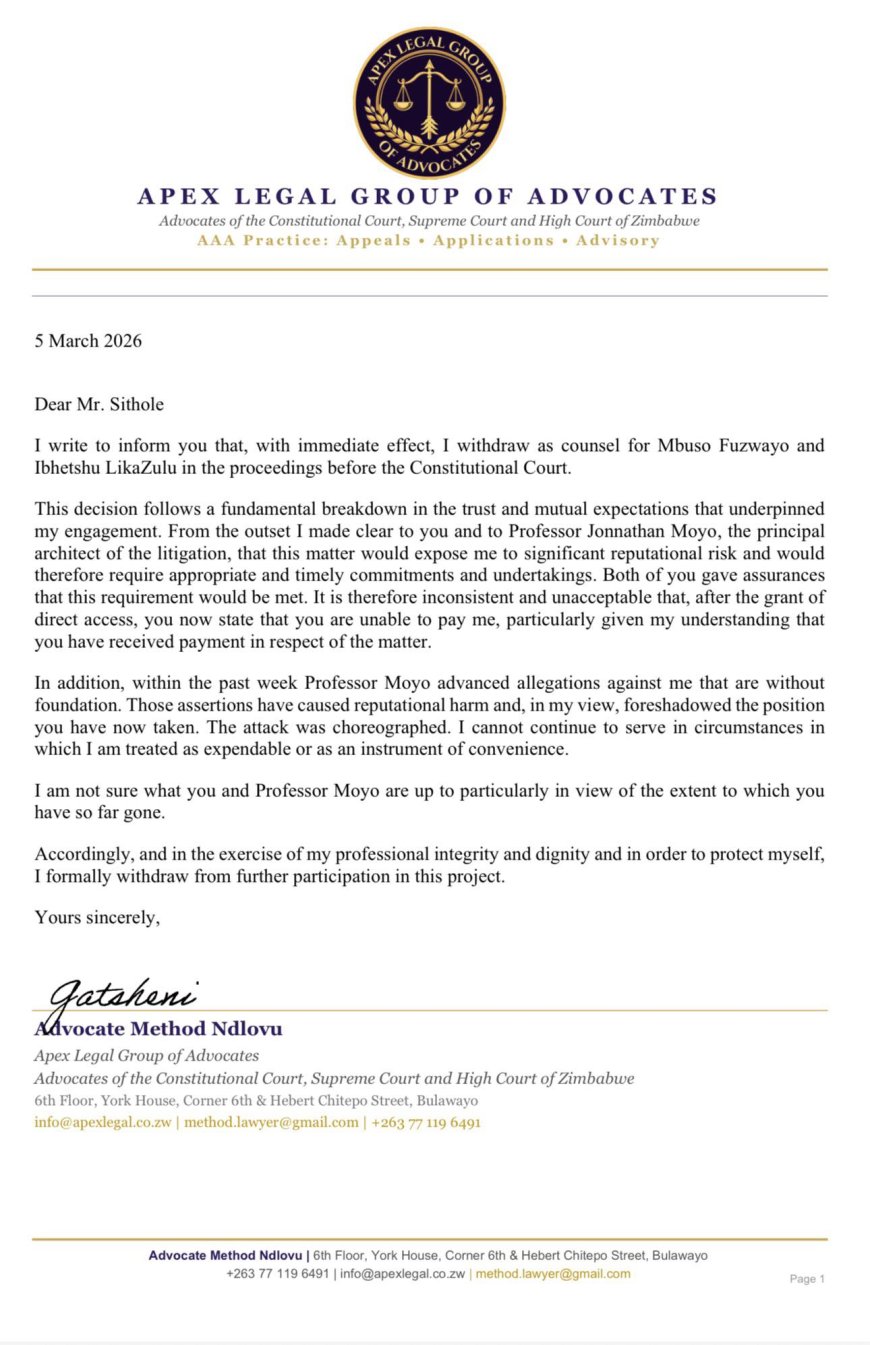
In one of Zimbabwe’s most closely watched legal battles, Advocate Method Ndlovu has formally withdrawn as legal counsel in a Constitutional Court case challenging a Zanu PF bid to extend President Emmerson Mnangagwa’s term beyond 2028.
The move leaves the litigation spearheaded by activist Mbuso Fuzwayo and the cultural organisation Ibhetshu LikaZulu in uncertainty, raising questions about the case’s future and the nationwide constitutional debate it has sparked.
In a letter dated 5 March 2026, Ndlovu informed co-counsel Nqobani Sithole that he was withdrawing with immediate effect. The correspondence, issued on behalf of Apex Legal Group of Advocates, cited a breakdown in trust, unpaid legal fees, and reputational attacks linked to the litigation.
Ndlovu said that from the outset, he had warned both Sithole and exiled former Education Minister Jonathan Moyo, whom he describes as the principal architect of the case, that taking on such a politically sensitive matter would carry significant reputational risks.
“Because of those risks, I required clear commitments and undertakings before agreeing to act,” Ndlovu said. “While assurances were given, they were not honoured.”
According to the advocate, matters worsened after the Constitutional Court granted direct access to the case, when he was informed that payment for his services could not be made, despite prior arrangements that funds had already been received.
Complicating the situation further, Ndlovu said, were public allegations made against him by Professor Moyo, which he described as baseless, orchestrated, and damaging to his professional reputation. “The attacks have caused reputational harm and signalled a breakdown in the professional relationship,” he wrote.
In a telephone interview, Ndlovu confirmed his withdrawal, describing the letter as “genuine and official” but expressed his shock over its widespread circulation on social media. “The communication was intended for professional purposes and not for public dissemination,” he said. “Seeing it on every social media platform left me shocked beyond words.”
Asked about his current focus, he said he was “refreshing and relaxing at my farm, away from the pressures of the legal profession.” He added: “Indeed, it is true—things do happen. You plan for one outcome, but sometimes events unfold differently. I am taking the time to step back, reflect, and recharge.”
The Constitutional Court challenge seeks to contest a Zanu PF resolution to extend Mnangagwa’s presidential term, directly linking to the controversial Constitution of Zimbabwe Amendment Bill No. 3. The bill proposes sweeping constitutional changes, including extending presidential and legislative terms from five to seven years and allowing the legislature, rather than the general electorate, to elect the President.
With the total legal bill reportedly amounting to US$450,000, the high stakes highlight both the political sensitivity and financial implications of the litigation. Legal analysts warn that Ndlovu’s withdrawal could undermine the momentum of the case and delay critical constitutional scrutiny.
So far, Fuzwayo and Sithole have not publicly commented on the development, leaving Zimbabweans and legal observers anxiously awaiting the next move. As the drama unfolds, the case continues to raise pressing questions about the balance of power, the integrity of Zimbabwe’s constitutional framework, and the role of the judiciary in arbitrating high-stakes political disputes.