Gweru High Court Moves to End Murder Case Backlog
Justice Munamato Mutevedzi has opened the Gweru High Court circuit, presiding over 39 murder trials from May 11–22, 2026. The special sitting aims to ease Midlands’ murder backlog, offering families and accused persons long-awaited justice and closure amid rising violent crimes.
 Dumisani Ndlovu
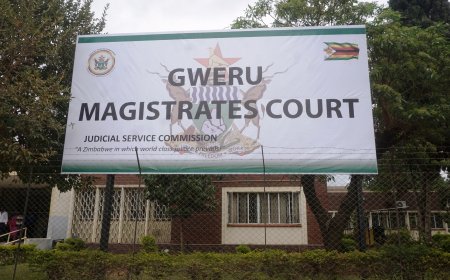
Gweru - The usually calm corridors of the Gweru Magistrates’ Court came alive on Monday morning as court officials, lawyers, police officers, families of accused persons and victims filled the premises for the official opening of the 2026 second High Court circuit in Midlands Province.
At the centre of the proceedings was Justice Munamato Mutevedzi, the Bulawayo High Court judge tasked with carrying the heavy responsibility of presiding over 39 murder trials during the two-week circuit sitting running from May 11 to May 22.
For many families, victims and accused persons, the arrival of the circuit court represents another legal session and long-awaited chance for justice, closure and resolution after years of delays.
Midlands Province has in recent years witnessed a disturbing rise in violent crimes, particularly murders linked to artisanal mining disputes and domestic conflicts.
From the dangerous gold-rich mining belts scattered across the province to densely populated communities battling social and economic hardships, deadly confrontations have become increasingly common.
Sources familiar with the cases say most of the matters set for trial involve artisanal gold miners accused of engaging in brutal fights over mining claims, gold ore and territorial control.
Others stem from crimes of passion, tragic incidents where jealousy, anger and broken relationships allegedly escalated into fatal violence.
Behind every homicide docket lies a painful story; grieving families waiting for justice, accused persons enduring lengthy pre-trial detention and communities still haunted by violence that shattered lives.
The Judicial Service Commission (JSC) introduced the special circuit court system to address mounting concerns over the growing backlog of murder cases in Midlands Province.
Unlike Harare, Bulawayo and Masvingo, Midlands does not yet have a permanent High Court, forcing serious criminal matters to be handled through rotating circuit courts.
The absence of a fully operational High Court in Gweru has for years created delays in the finalisation of cases, leaving many suspects languishing in prison while victims’ families wait endlessly for closure.
Although reports indicate that a new Midlands High Court is under construction in Kwekwe, the province continues to rely on temporary circuit sittings.
“It was established that there was a huge backlog of murder cases in Midlands and there is no permanent High Court there,” a source familiar with the arrangements revealed.
“In order to deal with the backlog, judges are periodically assigned to sit in Gweru so that serious criminal matters can be cleared," the source said.
What has particularly drawn attention this year is the scale of responsibility placed on a single judge.
In previous special sittings, up to five High Court judges were deployed to help reduce a backlog that once ballooned to nearly 500 cases.
This time however, Justice Mutevedzi will single-handedly preside over all 39 murder matters scheduled for the current circuit.
The development has sparked conversations within legal circles about the pressure facing Zimbabwe’s judiciary amid limited resources and growing case loads.
Despite the challenges, expectations remain high that the current circuit will help ease congestion within the criminal justice system.
While official figures mention “39 murder cases,” the reality stretches far beyond numbers.
Each case carries emotional scars, widowed spouses, orphaned children, broken families and traumatised communities.
For some accused persons, the circuit court may offer an opportunity to finally defend themselves after years in remand prison awaiting trial.
For grieving relatives of victims, it could be the beginning of long-awaited justice.
As court proceedings begin in Gweru, the atmosphere is one of cautious hope, hope that justice will not only be done, but also seen to be done.
The circuit is expected to conclude on May 22 before the High Court resumes its third term in September.