Former Intelligence Analyst Warns US Faces Risk of Authoritarianism
A former Australian intelligence analyst has released a simulated intelligence assessment warning that the United States faces a growing risk of "competitive authoritarianism", arguing that the convergence of executive power and major technology interests could weaken democratic institutions ahead of future elections.
 Harry Taruva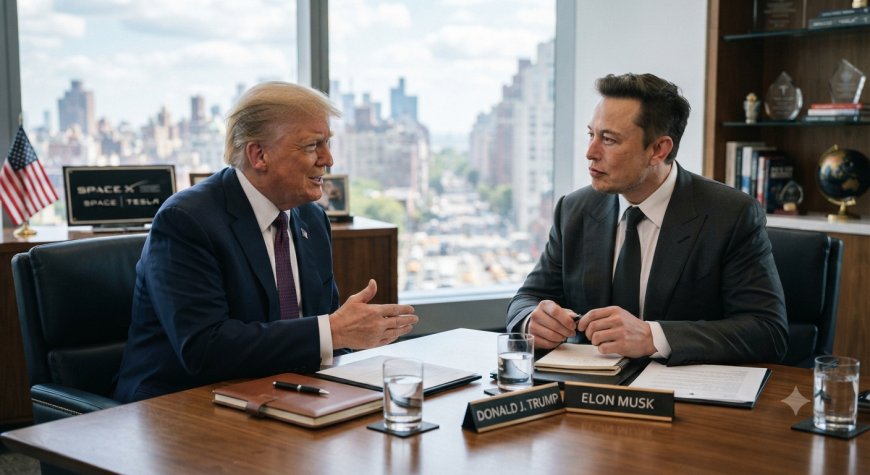
Sydney — A former Australian intelligence analyst has released a simulated intelligence assessment warning that the United States of America is facing an increasing risk of "competitive authoritarianism," arguing that the convergence of executive power and influential technology billionaires could undermine democratic institutions ahead of future elections.
The discussion document, prepared by the Social Cyber and Tech Academy for an executive workshop, was coached and prompted by Adjunct Professor Greg Austin of the University of Technology Sydney.
Produced using two artificial intelligence systems, the report carries a disclaimer stating that it is a simulated assessment, has not been fully verified and does not necessarily represent the views of the Social Cyber Institute or the Social Cyber and Tech Academy.
The assessment says "a coalition of executive-branch actors and aligned technology wealth is weakening the constraints on executive power" and facilitating the consolidation of anti-democratic forces.
The report says this represents a convergence of interests, not a directed conspiracy, while warning that the cumulative effects could erode democratic safeguards.
They argue that some technology companies have, by default, established the infrastructure that could lower the barriers to an anti-democratic takeover should such an attempt be made.
"We flag it not because we assess a coup is being engineered through it, we do not, but because it is the mechanism that would most lower the cost of one, and because its trajectory is a genuine intelligence gap the alliance has not addressed," the assessment states.
The document identifies the Federal Bureau of Investigation (FBI) as a potentially decisive institution in any future constitutional crisis.
"The federal paramilitary layer is the active front, and this is where the assessment differs most from public commentary focused on the army," it states, adding that local sheriffs are of particular concern because they are "elected, armed, jurisdictionally entrenched and, in a contested electoral scenario, positioned to act against county election administration rather than for it."
The report also warns that mobilised armed citizens represent an irregular front that is latent but no longer negligible.
"Alongside them sits the private-security ecosystem around the oligarchy's principals and the surveillance stack ... which gives every layer of this apparatus a targeting reach that historical analogues lacked," the report says.
The assessment concludes that the system is under attack and resisting at once; which prevails is genuinely uncertain.
Professor Austin said he believed the report's conclusions deserved serious consideration despite its simulated nature.
"The United States is in a fight of its political life and this struggle threatens the security and economic prosperity of its closest allies," he said.
"Several tech billionaires are heavily engaged in this fight and have the infrastructure resources to tip the balance in favour of the anti-democratic forces.
"We do not have a full picture of their intent or operations to overthrow the democratic system," Prof Austin said.
He said technology platforms had increasingly become drivers of major political change.
"The emergence of tech platforms as determining forces for radical political change has been in evidence at least since the Arab Spring beginning in 2010," he said, adding that "There is now little reason to assume that the US can still remain immune to these forces."
Intelligence professionals would recognise the balanced approach adopted in the simulated assessment, he said, while noting the significance of the intelligence gaps it identifies.
"People who have worked in the allied intelligence community will relate to the careful balancing evident in this simulated assessment, but we should note the seriousness and depth of key intelligence gaps," Austin said.