
Done Deal: New Dawn for Zimbabwe Energy Sector Becomes Reality, as Invictus, Gvt Sign PPSA on Muzarabani Petroleum Project
Australian Invictus Energy has executed a landmark Petroleum Production Sharing Agreement (PPSA) with the Zimbabwe government for the Cabora Bassa project. Backed by a recent ten million dollar capital raise, the company is advancing procurement and contractor selection to spud the shallow Masuma One vertical well in the second half of 2026, targeting an estimated 1.2 trillion cubic feet of gas and seventy-three million barrels of condensate to pioneer early gas-to-power monetization.
 Harry Taruva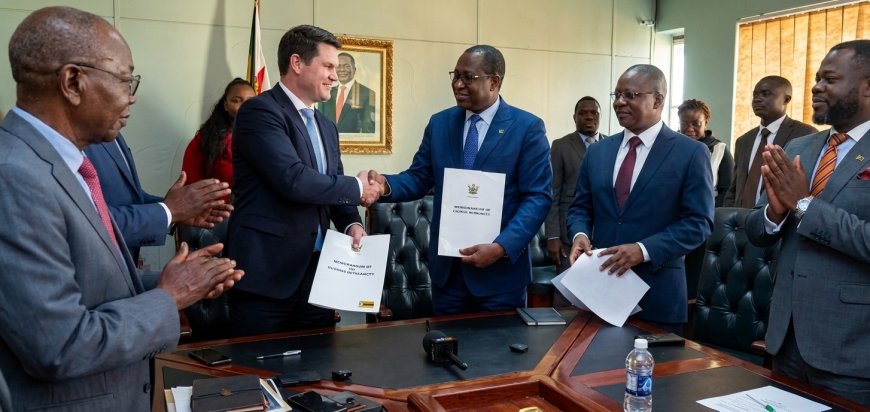
Harare, Zimbabwe - For decades, the Muzarabani district in northern Zimbabwe has been known for its intense heat, cotton farming and vast wildlife. But miles beneath this dry terrain lies a different kind of wealth, one that could transform the economic fortunes of an entire nation.
The Cabora Bassa Basin has become the focal point of a multi-million-dollar frontier exploration project led by Invictus Energy, an independent Australian firm that holds a dominant 360,000-hectare license in the area.
Now, after years of legal delays and drilling setbacks, the project has secured the commercial framework required to move from high-risk exploration to potential production.
A Blueprint for a New Industry
"This is a momentous day for the company," announced Invictus Energy Chief Executive Officer, Scott Macmillan, following the formal execution of a Petroleum Production Sharing Agreement (PPSA) with the Zimbabwean state on Thursday, May 28.
Speaking from a detailed webinar briefing to investors, Macmillan noted that the agreement had been a "long time coming" and followed an arduous and often frustrating negotiation process.
"It is a very important agreement," Macmillan explained. "It will dictate the future of the industry in the country for decades to come. It was important that we got it right and now that it's settled, we can go forward in confidence," he said.
The contract is designed to provide ironclad fiscal stability. For a country that has not seen a major petroleum regulatory update, creating a predictable legal structure was critical to convincing international lenders to invest.
Unlike a basic exploration permit signed in 2021, which lacked clear tax terms, the new hybrid agreement binds three key state bodies which include the ministries of Mines, Energy and Finance.
It ensures that the "rules of the game" cannot be unilaterally altered by future administrations.
Balancing the State's Share
The commercial framework relies on a sliding-scale profit-sharing model.
In the expensive early phases of development, Invictus is permitted to recover its exploration costs rapidly under a low profit-share obligation to the state.
However, if a major commercial discovery is made and global commodity prices spike, the government's share of the extracted gas automatically increases.
To ensure an equitable deal, the Zimbabwean authorities sought independent legal and financial expertise through the African Legal Support Facility, an arm of the African Development Bank.
The final terms were rigorously benchmarked against regional energy hubs like Namibia and South Africa.
Representing the state's direct interest, the Mutapa Investment Fund, Zimbabwe’s sovereign wealth fund, holds a 10% back-in right.
This guarantees the citizens of Zimbabwe a direct equity stake in the project the moment a formal production license is gazetted.
The agreement also capitalises on sweeping domestic reforms, including Special Economic Zone status, which grants Invictus capital gains tax exemptions and the right to transact through offshore banking systems, completely separate from local currency volatility.
The Upcoming Test at Musuma One
With the legal architecture finalised, attention now shifts to the engineering challenges of a remote, landlocked basin.
Invictus is moving ahead with plans to spud the Musuma One well in the second half of this year, backed by a recent US$10 million capital raise.
Civil works on the well pad are expected to begin shortly alongside maintenance on the massive Exalo Rig 202, currently stacked at the previous Mukuyu Two site.
"We are progressing the drilling services, procurement and contractor selection," Macmillan stated, adding that formal contracts are slated for award next month, June.
"The contractors that we select and their equipment availability will dictate the exact spud date," he said.
Geologists have highlighted Musuma One as an exceptionally attractive target, estimating it holds 1.2 trillion cubic feet of gas and 73 million barrels of condensate.
Seismic surveys captured in 2023 revealed a distinct flat spot, an amplitude shift that serves as a direct hydrocarbon indicator, suggesting a clear boundary between gas, oil and water phases beneath the surface.
As Musuma is a shallower prospect, the company said it requires a simple, low-cost vertical well costing between US$6 million and US$10 million.
Invictus executives confirm that despite global oilfield inflation, current contractor quotes remain firmly within the budget.
A Phased Path to Power
The company says if the Musuma well yields positive results, it will trigger an immediate shift in how energy is supplied to Zimbabwe's struggling electrical grid.
"If this works, then we'll focus our efforts on this side of the basin for the time being for an early monetisation scheme," Macmillan revealed, detailing a modular strategy to bring gas online quickly without needing to drill out the entire basin first.
The cornerstone of the plan is the Eureka gas-to-power pilot project, which aims for a final investment decision within the next 12 to 18 months.
The pilot will demonstrate whether the company can process raw gas and deliver it directly to industrial customers.
The wider project still holds significant potential. Macmillan says to the west, the confirmed Mukuyu gas field awaits a future 3D seismic campaign and an appraisal well at Mukuyu Three.
To the south, engineers are monitoring a liquid-prone basin margin play where residual oil was previously detected.
Furthermore, the resolution of the PPSA has unblocked stalled joint-venture discussions with major global exploration firms, many of whom possess their own internal oilfield service lines.
The Regional Impact
For Zimbabweans enduring routine power cuts, the stakes extend far beyond corporate balance sheets.
Local industrial analysts note that a reliable, domestic supply of gas-fired electricity could revitalise the country’s manufacturing and mining sectors, which currently rely on expensive power imports from neighboring South Africa and Mozambique.
While deep-basin exploration always carries a high risk of failure, the completion of the legal framework means the drills will restart in the Zambezi Valley with unprecedented financial backing and legal security.
The coming months will determine whether the gas beneath Muzarabani can successfully power Zimbabwe's industrial future.